
 Nila Kartika Wati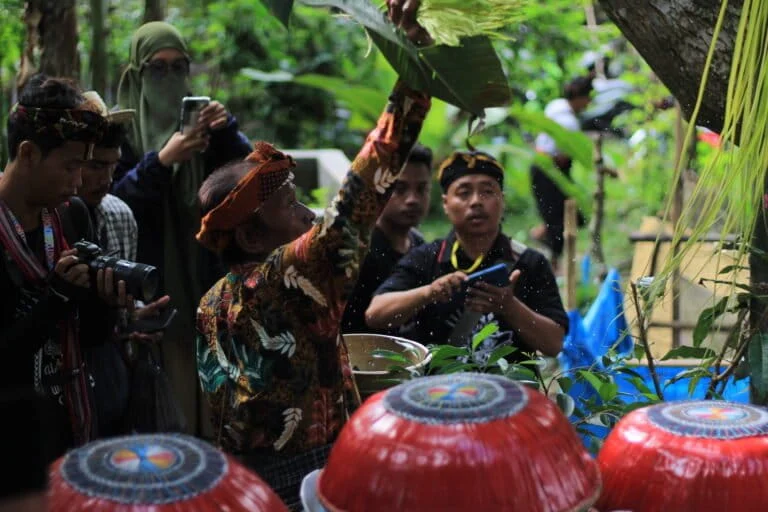
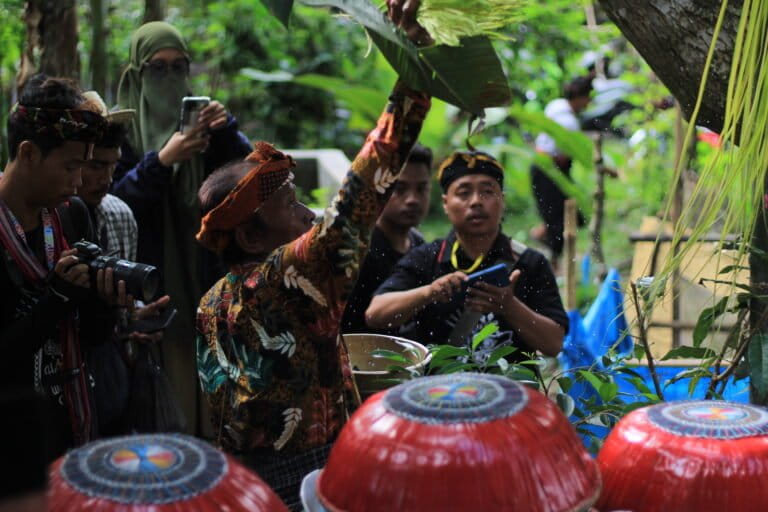
The courtyard of Amaq Marni’s residence in Kesik Village, Masbagik, East Lombok, serves as the epicenter of a profound communal effort. Here, villagers gather in a rhythmic choreography of preparation, meticulously organizing rice, glutinous rice, and coconuts—the essential ingredients for the Nunas Nede ritual. This annual tradition, observed by the residents of Desa Kesik as the region transitions from the harsh dry season to the anticipated rains, is far more than a cultural performance; it is a critical socioeconomic mechanism for environmental stewardship and survival. For a community whose livelihoods are inextricably linked to the unpredictable nature of agriculture, the arrival of rain is not merely a meteorological event but the lifeblood of their economic sustainability.
The Spiritual and Ecological Significance of Nunas Nede
The Nunas Nede ritual is rooted in the belief that human survival is tethered to the health of the natural ecosystem. The ceremony begins with a symbolic gathering of water from seven distinct springs located throughout the village. These waters are ceremonially unified in a single vessel, representing the interconnectedness of all life and the collective blessing of the land. The community then engages in collective prayer and communal dining, reinforcing the social fabric that sustains them during lean times.
Amaq Marni, a 73-year-old customary leader, emphasizes that the ritual serves as a poignant reminder of the responsibility to protect vital resources. "Water is not just for human consumption; it is the essence of life for all living creatures," Marni states. "If the springs are destroyed, the fields wither, and eventually, human existence itself is threatened." This philosophy drives the physical labor that follows the spiritual observance. The ritual acts as a catalyst for "gotong royong," or mutual cooperation, where villagers undertake the arduous task of desilting springs, clearing debris from irrigation channels, and launching reforestation initiatives in the hills surrounding the village.
The Socio-Economic Context of Water Scarcity
The urgency behind Nunas Nede has intensified in recent years due to shifting climatic patterns. Indonesia, an archipelagic nation heavily dependent on rain-fed agriculture, has seen significant disruptions to its traditional planting calendars. In East Lombok, the oscillation between prolonged droughts and erratic, heavy downpours has created a state of agricultural insecurity.
Data from the Indonesian Agency for Meteorology, Climatology, and Geophysics (BMKG) indicates that shifts in the Indian Ocean Dipole (IOD) and El Niño-Southern Oscillation (ENSO) cycles have made precipitation patterns increasingly difficult to forecast. For farmers like Amaq Sati, who has participated in Nunas Nede since childhood, the predictability of the seasons—once a reliable rhythm—has vanished. "In the past, the seasons were easy to predict. Now, the rains are either significantly delayed or arrive with such intensity that they cause soil erosion rather than replenishment. We are constantly in a state of uncertainty," Sati explains.
This uncertainty carries significant economic weight. When springs dry up, the irrigation systems that support the village’s primary crop yields fail. The loss of water access leads to crop failure, a decrease in household income, and increased dependence on external food supplies. Consequently, the preservation of the forest canopy around these springs—a practice protected by the village’s unwritten customary laws—is not just a cultural heritage but a vital adaptation strategy to mitigate the impacts of climate change.
Legislative and Traditional Synergy: Protecting Local Springs
The governance of natural resources in Desa Kesik is a hybrid of formal administrative leadership and traditional customary law. Muhamad Kadri, the Village Head of Kesik, highlights that the majority of the village’s agricultural land relies entirely on gravity-fed irrigation originating from natural springs. "For us, water security is food security. If we lose the springs, we lose our livelihood," Kadri states.
The village maintains strict, albeit unwritten, prohibitions against deforestation in designated catchment areas. These traditional regulations, enforced by the community elders, often carry more weight than abstract governmental policies. The ritual of Nunas Nede serves as the enforcement mechanism for these rules; by bringing the community to the springs, the elders ensure that the younger generation is educated on the precise boundaries of protected land and the consequences of environmental degradation.
This intergenerational transfer of knowledge is critical. As Kadri notes, "If the younger generation is not introduced to the reality of water management early on, they will grow up believing that water is an infinite resource that simply flows from a tap. We must teach them that every drop is the result of a healthy forest ecosystem."
Comparative Analysis: Traditional Knowledge and Modern Challenges
The Nunas Nede ritual stands as a resilient example of "Nature-based Solutions" (NbS). While modern engineering focuses on large-scale dams and concrete infrastructure, the community in Kesik opts for an approach centered on ecosystem restoration. Scientific literature increasingly supports this model, suggesting that forest cover in catchment areas regulates water discharge, prevents sedimentation in irrigation channels, and mitigates the severity of floods during the wet season.
However, the challenge remains in scaling these local efforts. While Desa Kesik has successfully protected its springs, surrounding regions often face the pressure of land conversion for commercial crops, which disrupts the hydrological cycle on a landscape level. The conflict between short-term commercial gain and long-term ecological stability remains a persistent hurdle for rural communities across Nusa Tenggara Barat.
Future Implications and the Tourism Paradox
The growing recognition of Nunas Nede has piqued the interest of outside visitors and researchers, raising concerns about the potential commercialization of the tradition. There is a delicate balance to be maintained: while tourism can provide economic incentives for cultural preservation, it risks transforming a solemn act of environmental stewardship into a shallow performance.
The villagers are acutely aware of this risk. They have made it clear that the primary objective of the ritual is to ensure the sustainability of their water supply and the continuity of their agricultural legacy. By keeping the focus on labor—cleaning the springs, planting trees, and maintaining the infrastructure—the community ensures that the ritual remains a living, functional practice rather than a static exhibit.
As the village prepares for the coming season, the message remains clear: the survival of the community is tied to their ability to harmonize with the environment. Through Nunas Nede, the residents of Kesik continue to demonstrate that the most effective climate adaptation strategies are often those that have been practiced for generations, refined by time, and held together by the strength of a community working toward a shared, sustainable future.
Chronology of the Ritual and Environmental Stewardship
- Pre-Ritual Preparation (Early Transition Season): Residents gather resources, including rice and traditional offerings. Coordination meetings are held to identify areas of the village water infrastructure requiring urgent repair.
- The Ritual Observance (Transition Period): The collection of water from the seven springs occurs. This is followed by communal prayers and the ceremonial unification of the water.
- The Action Phase (Post-Ritual): Following the spiritual event, the community mobilizes for physical labor. This includes cleaning debris from the spring heads, fixing leaking pipes, removing sedimentation from canals, and conducting reforestation drives.
- Maintenance Phase (Ongoing): The implementation of customary "no-cut" zones around the springs. Elders monitor the forest edge, and younger members are tasked with regular inspections of the irrigation flow to ensure efficiency.
- Evaluation and Reflection: During village meetings, the effectiveness of the water supply during the previous season is assessed, and plans for the next year’s ritual are discussed, incorporating lessons learned from the recent weather patterns.
By bridging the gap between traditional spirituality and practical environmental management, the people of Desa Kesik provide a blueprint for how rural communities can remain resilient amidst the global climate crisis. Their reliance on collective action ensures that even as the world around them changes, the springs that have fed their ancestors remain a reliable, protected source of life for the generations to come.









