Nila Kartika Wati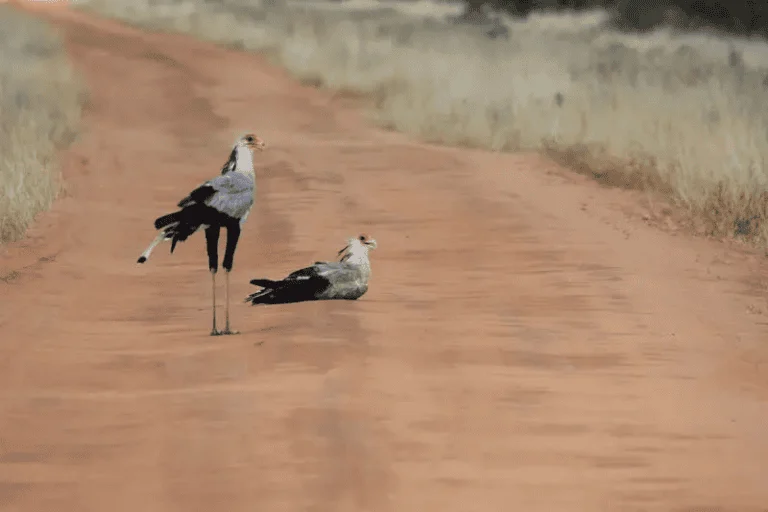
In the vast, shimmering grasslands of sub-Saharan Africa, the traditional rules of avian predation are frequently cast aside. While most raptors, such as the peregrine falcon or the martial eagle, are defined by their mastery of the thermals and high-velocity aerial descents, the Secretary Bird (Sagittarius serpentarius) has carved out a unique ecological niche by mastering the ground. Standing nearly 4.5 feet tall on stilt-like legs, this formidable predator represents a radical departure from the typical raptor blueprint. Rather than relying on the crushing grip of its talons from a diving stoop, the Secretary Bird employs a strategy of brutal, high-speed terrestrial combat, utilizing a kicking force that is among the fastest and most powerful in the animal kingdom.
The Secretary Bird is a biological anomaly. Though it is taxonomically grouped within the order Accipitriformes—sharing a common ancestry with hawks, eagles, and vultures—it is the sole extant member of its own family, Sagittariidae. Its common name is often attributed to the crest of long, black feathers at the back of its head, which nineteenth-century Europeans thought resembled the quill pens that legal clerks, or secretaries, once tucked behind their ears. However, its regal appearance belies a predatory efficiency that has fascinated biologists and biomechanical engineers alike.
The Biomechanics of a Lethal Strike
The true extent of the Secretary Bird’s physical prowess was brought to light through a seminal study published in the journal Current Biology. A team of researchers from the Royal Veterinary College, the University of London, and the Hawk Conservancy Trust undertook a rigorous biomechanical analysis of the bird’s hunting technique. The focal point of this research was a male Secretary Bird named Madeleine, housed at the Hawk Conservancy Trust in Hampshire, United Kingdom.
To measure the force and speed of the bird’s strike, researchers trained Madeleine to attack a rubber snake placed atop a hidden force plate. The results were nothing short of extraordinary. The study revealed that the Secretary Bird can deliver a kick with a peak force of 195 Newtons. To put this in perspective, this force is approximately five times the bird’s own body weight. If a 180-pound human male were to possess a proportional level of power, his kick would strike with the equivalent force of nearly half a ton of pressure, concentrated into a single, localized point of impact.
Even more impressive than the raw power is the temporal precision of the strike. The researchers discovered that the contact duration between the bird’s foot and its prey lasts a mere 15 milliseconds. For comparison, the average human eye blink takes between 100 and 150 milliseconds. This means the Secretary Bird’s lethal blow is delivered ten times faster than a human can blink. At such speeds, the strike is virtually invisible to the naked eye and far exceeds the neurological reaction time of most prey species, including highly agile venomous snakes.
Neural Pre-Programming: The Feed-Forward Mechanism
The extreme speed of the Secretary Bird’s kick presents a fascinating neurological challenge. In typical animal movements, the brain uses "closed-loop" or sensory feedback to adjust a limb’s trajectory in real-time. For instance, if a human reaches for a glass of water, the brain constantly processes visual and tactile information to guide the hand accurately. However, at a contact time of 15 milliseconds, there is no time for such feedback loops.
Biologists conclude that the Secretary Bird utilizes what is known as a "feed-forward" or "pre-programmed" strike. Because the duration of the impact is shorter than the time it takes for a nerve impulse to travel from the foot to the brain and back again, the bird cannot correct its aim once the leg is in motion. Instead, the bird’s nervous system must calculate the exact position of the target, account for movement, and commit to a full-force strike before the foot even leaves the ground. This requires an incredible level of visual-motor coordination and spatial awareness, as the target is often the small, erratic head of a venomous serpent.
Evolutionary Adaptation to the African Savanna
The evolution of this specialized hunting style is a direct response to the environmental pressures of the African savanna. The sub-Saharan landscape is dominated by tall grasses and vast open plains with limited high-altitude perches. In such an environment, the traditional raptor strategy of "perch and pounce" is less effective because the dense ground cover conceals movement from above.
The Secretary Bird adapted by becoming a terrestrial specialist. It is a nomadic hunter, often walking up to 20 or 30 kilometers in a single day to find food. Its long legs are not merely for height; they act as powerful levers that provide a massive range of motion and mechanical advantage during a strike. Furthermore, these long limbs serve as a vital safety buffer. By standing tall, the bird keeps its vulnerable face, eyes, and torso well away from the striking range of a cornered snake.
When hunting, the Secretary Bird employs a "flush and crush" tactic. It walks through the grass with deliberate, heavy steps, using the vibration and noise to startle hidden animals. When a prey item—be it a lizard, a rodent, or a snake—is flushed out, the bird does not immediately use its beak. Instead, it uses its wings as massive feathered shields to distract the prey and maintain balance, then launches its rapid-fire kicks.
The Snake Hunter’s Risk Management
While the Secretary Bird’s diet is varied, its reputation as a "snake-killer" is well-earned. Dealing with venomous species like the Puff Adder or the Cape Cobra requires more than just strength; it requires a sophisticated understanding of defensive timing.
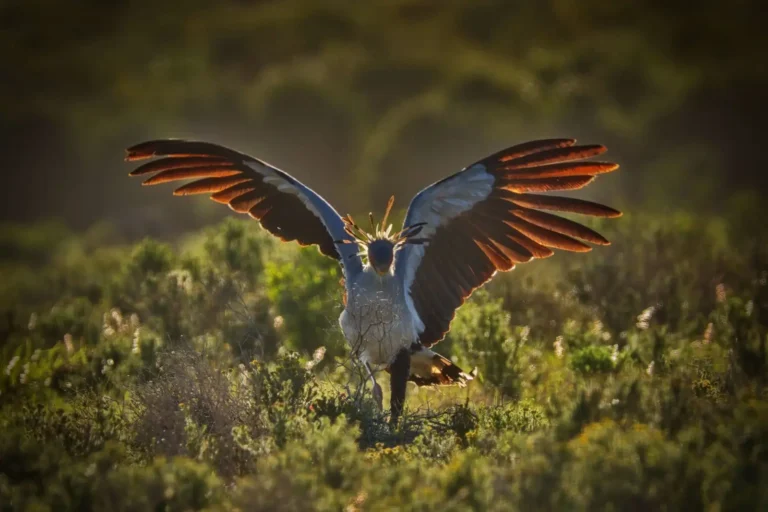
The bird’s feathers on its legs are thick and provide some level of protection, but its primary defense is distance. During an encounter with a cobra, the Secretary Bird will spread its wings to appear larger and to present a confusing, non-vital target for the snake to strike at. As the snake lunges, the bird utilizes its superior reach to deliver a crushing blow to the snake’s head or spine. A single successful kick is usually enough to shatter the skull or sever the spinal cord, instantly neutralizing the threat of venom.
Taxonomic Context and Global Significance
For many years, the Secretary Bird was a source of taxonomic confusion. Its long legs and terrestrial habits led early naturalists to believe it was related to cranes or storks. However, modern molecular phylogenetics has confirmed its place among the raptors. It represents an ancient lineage that diverged from other birds of prey approximately 40 million years ago.
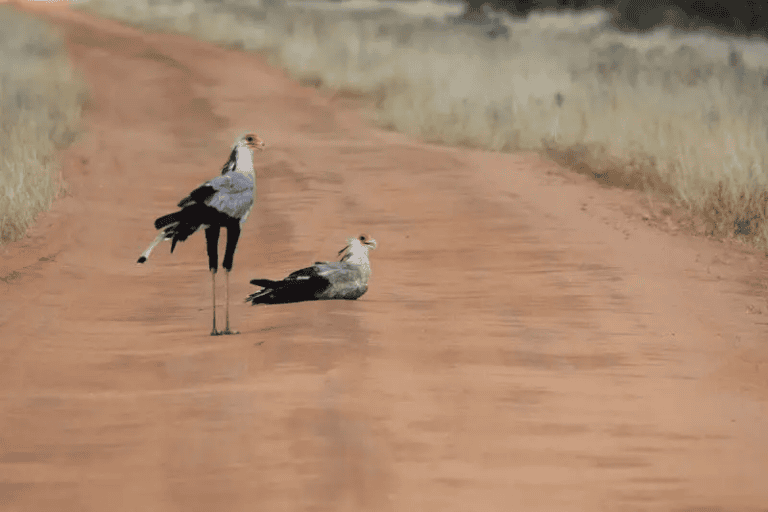
This evolutionary isolation makes the Secretary Bird a "living fossil" of sorts—a remnant of a time when terrestrial "terror birds" were more common. Today, it stands as the only bird of prey that hunts almost exclusively on foot, filling a gap in the ecosystem that no other raptor can occupy.
Conservation Status and Ecological Implications
Despite its prowess, the Secretary Bird is currently facing significant survival challenges. The International Union for Conservation of Nature (IUCN) currently lists the species as Endangered. Populations across Africa have seen a sharp decline over the last three decades. The primary drivers of this decline are habitat loss due to agricultural expansion, overgrazing by livestock which reduces prey availability, and secondary poisoning. In many regions, farmers use pesticides and rodenticides that work their way up the food chain, eventually killing the apex predators that consume the poisoned pests.
The loss of the Secretary Bird would have a cascading effect on the savanna ecosystem. As a primary regulator of snake and rodent populations, their absence could lead to an imbalance in prey species, potentially increasing the frequency of human-wildlife conflict in rural African communities.
Analysis of Scientific and Technological Impact
The study of the Secretary Bird’s kick has implications that extend beyond ornithology. In the field of biomimicry and robotics, engineers are looking at the Secretary Bird’s leg structure and neural programming to design more efficient bipedal robots. The ability to deliver high-force impacts with minimal contact time is a highly sought-after trait in mechanical design, particularly for robots intended to navigate uneven terrain or perform high-speed tasks.
Furthermore, the "feed-forward" mechanism of the bird provides a biological model for artificial intelligence systems that require "predictive processing." Just as the bird must predict where a snake’s head will be 15 milliseconds into the future, autonomous systems must learn to make split-second decisions without waiting for a full cycle of sensor data.
Conclusion
The Secretary Bird is a testament to the creative power of evolution. In a world where most birds sought the safety of the sky, this species returned to the earth, transforming its anatomy into a precision weapon. From the 195 Newtons of force delivered by Madeleine the bird to the ancient lineages that survived millions of years of climate change, the Secretary Bird remains one of the most remarkable predators on the planet. Its survival is not just a matter of biodiversity, but a necessity for maintaining the delicate equilibrium of the African wilderness. As researchers continue to peel back the layers of its biomechanical secrets, the Secretary Bird stands as a tall, feathered reminder that in the natural world, sometimes the most effective way to conquer the horizon is to stay firmly on the ground.