Nila Kartika Wati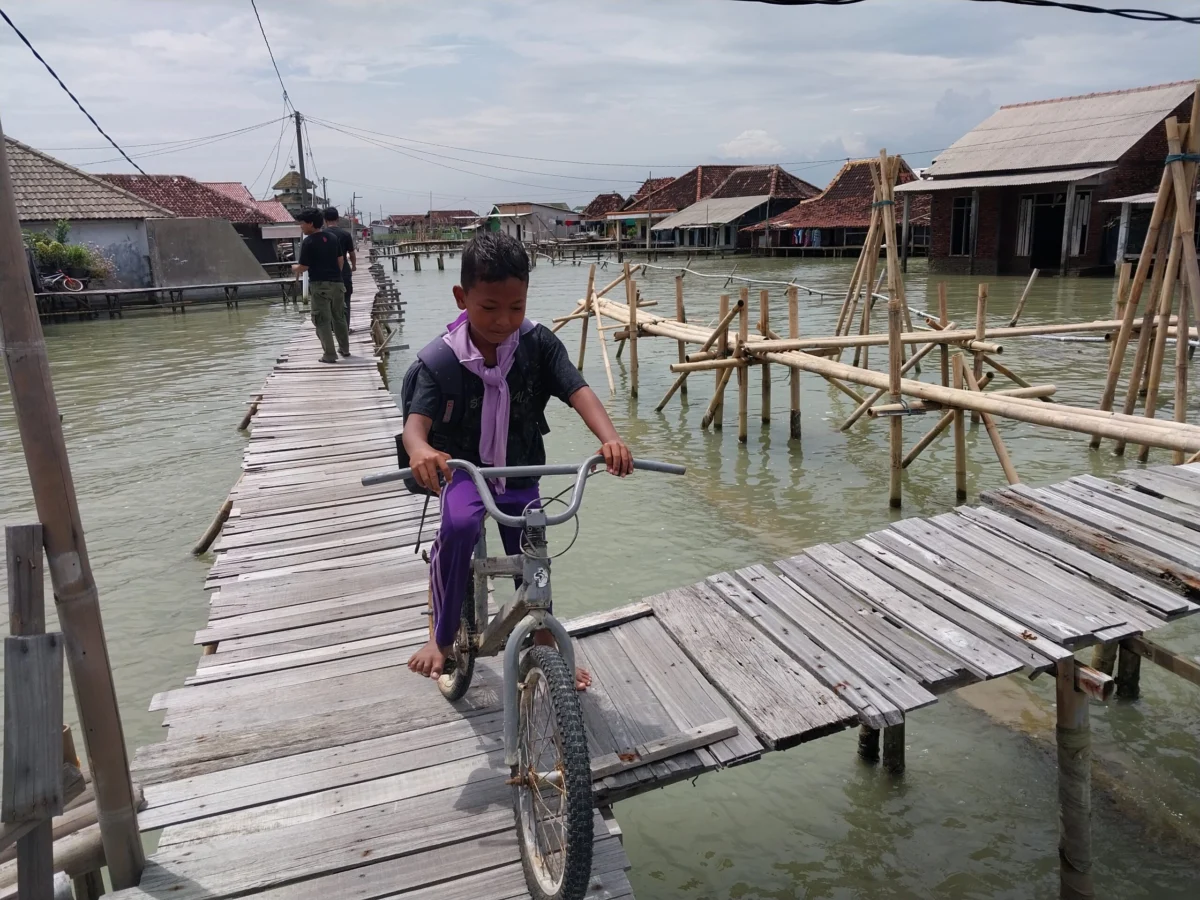
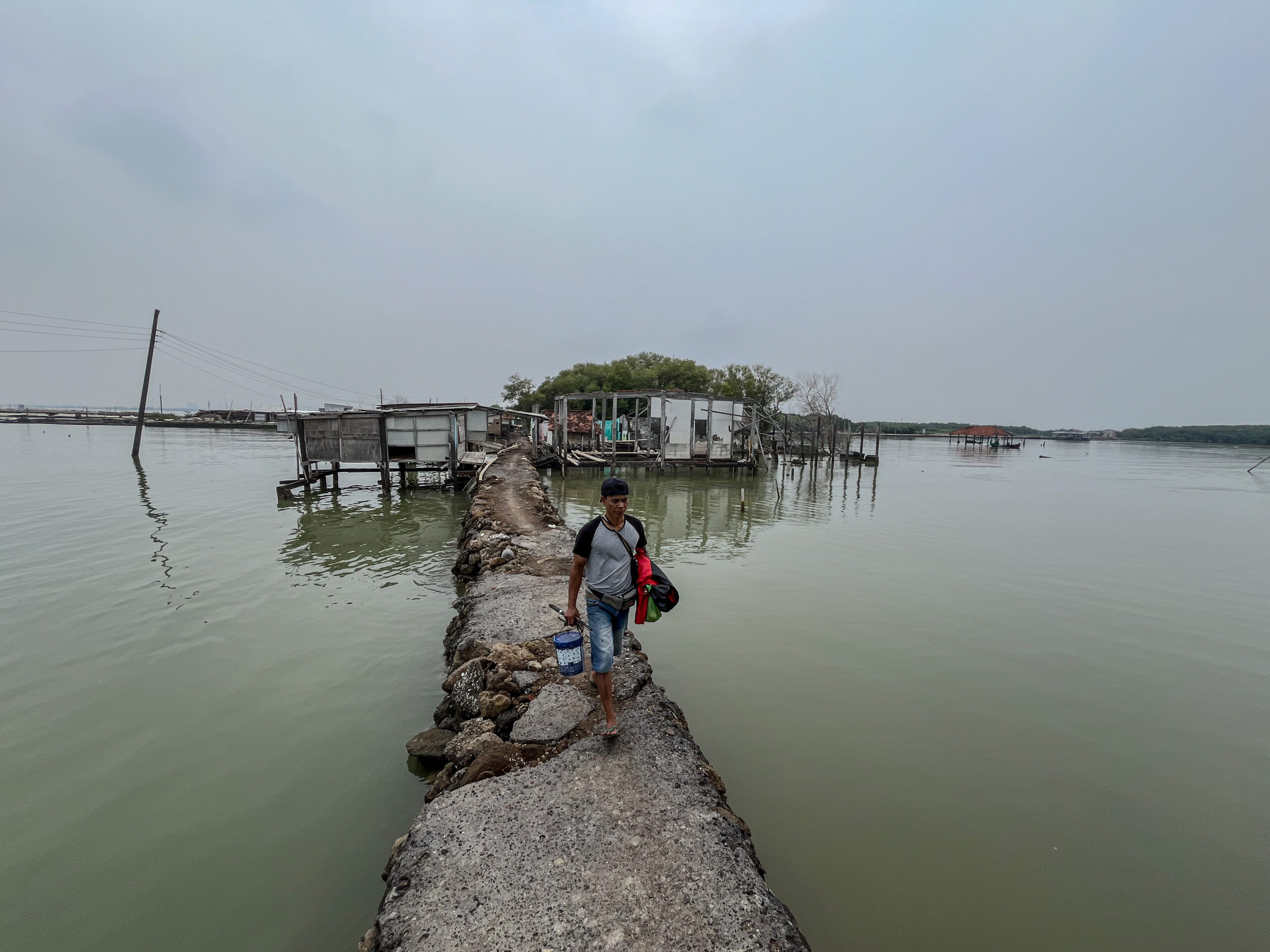
The landscape of the northern coast of Java is undergoing a violent transformation that is as much economic as it is environmental. In the Sayung District of Demak, Central Java, the sight of rooftops peering out from the Java Sea has become a hauntingly common tableau. Over the span of just three decades, what were once fertile agricultural fields and productive aquaculture ponds have been swallowed by rising tides and a sinking earth. This slow-motion catastrophe has displaced thousands, but as the water rises, a new predatory force has emerged: land speculators. Exploiting the desperation of residents whose assets are literally underwater, these brokers are purchasing submerged land for as little as the price of a snack, banking on a future where the state revitalizes these "lost lands" for massive industrial expansion.
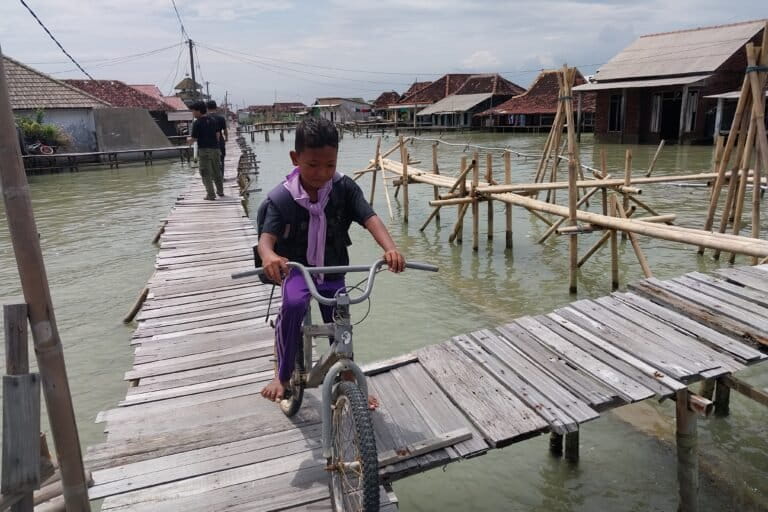
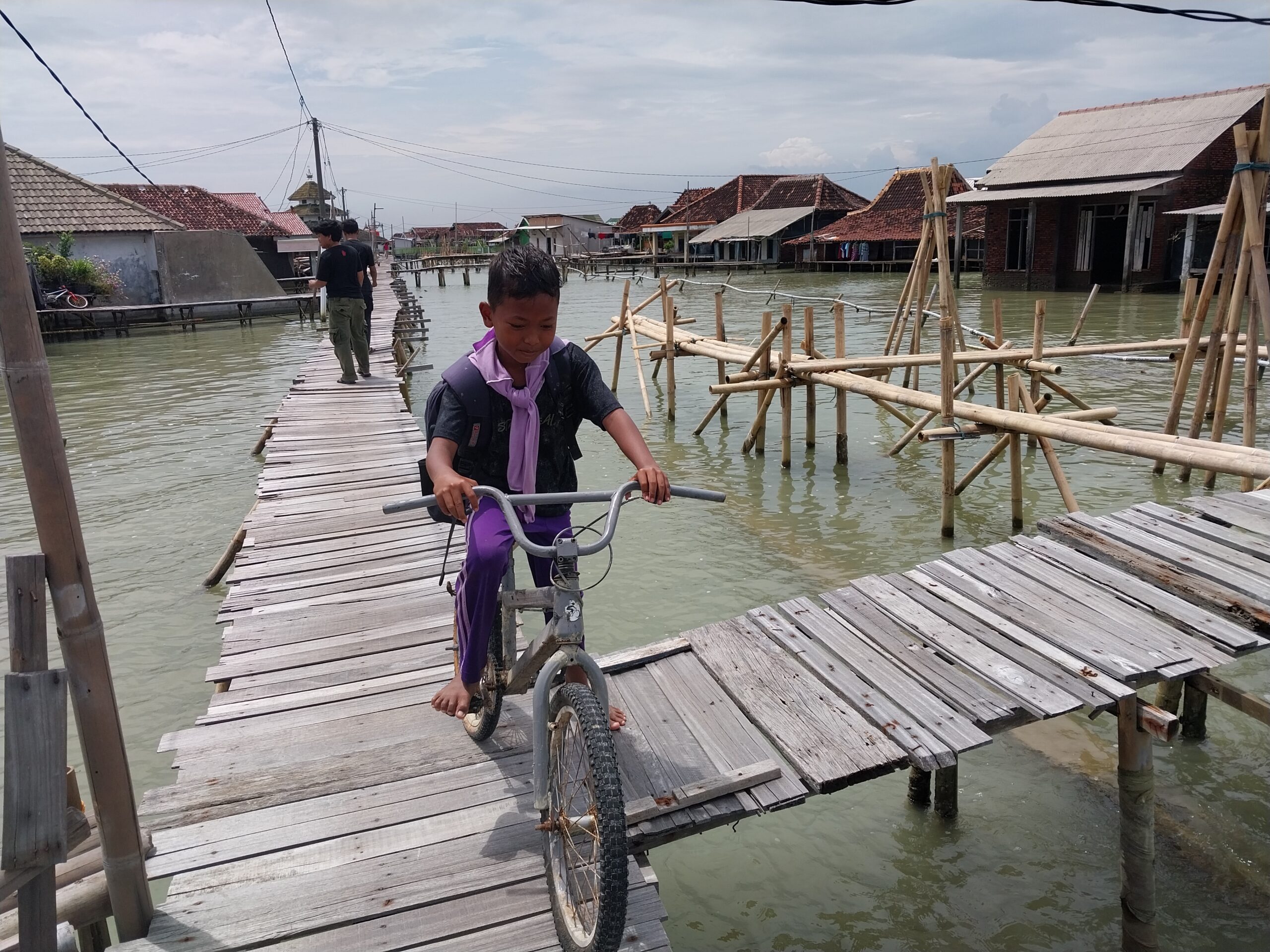
The chronology of this disaster began in the 1990s. At that time, tidal flooding, locally known as "rob," was a minor, seasonal inconvenience, rarely rising more than a few centimeters. However, the equilibrium shifted rapidly at the turn of the millennium. A combination of global sea-level rise and catastrophic land subsidence—caused largely by excessive groundwater extraction for industrial use in nearby Semarang—accelerated the inundation. By the 2010s, the floods were no longer retreating. In Timbulsloko, one of the hardest-hit villages, a community that once numbered hundreds of families has dwindled to approximately 70. Those who remain live in houses raised on stilts or concrete blocks, connected by precarious wooden walkways, while their original ground floors serve as artificial reefs for small fish.
For the residents of Sayung, the choice is often between staying in a watery grave or fleeing with nothing. Those with the financial means have long since self-relocated to higher ground. However, for the majority, the economic squeeze is suffocating. This has forced many to sell their "underwater certificates" to land brokers. Baharuddin, a resident who saw his livelihood vanish as his ponds turned into open sea, sold his land in 2023 for a mere Rp20,000 (approximately $1.25) per square meter. His reasoning was pragmatic and tragic: the land was no longer productive, and any attempt to rebuild a pond would be destroyed by the next wave. Another resident, Zaini, accepted an even lower offer of Rp15,000 per square meter in early 2024, using the meager proceeds to fund a small market stall and renovate his child’s house.
The Rise of the Land Brokers and the Industrial Mirage
The presence of land brokers in sinking villages like Bedono and Timbulsloko is not a coincidence. Residents report that these intermediaries are often acting on behalf of "big bosses" or corporate interests who view the submerged coast as a long-term investment. Rohmad, a resident of Bedono, recalled selling his land for just Rp8,000 per square meter in 2015. At the time, he was desperate for funds to build a new home in a relocation area. Other neighbors have reported offers as low as Rp700 to Rp2,000 per square meter—prices that reflect the total loss of the land’s current utility but ignore its future strategic value.
The underlying motivation for these purchases is tied to the government’s ambitious spatial planning. While the land is currently useless to a small-scale farmer, it sits within a high-value development corridor. According to Susan Herawati, Secretary General of the People’s Coalition for Fisheries Justice (KIARA), there is a disturbing pattern of state neglect that facilitates this private land grab. She suggests that the government is waiting for the population to vacate the area before reclassifying the territory. Once the residents are gone and the land is declared "musnah" (extinct or lost), the state can step in to facilitate reclamation and industrial redevelopment under the guise of "revitalization."
This suspicion is supported by regional planning documents. The Sayung District is a centerpiece of the Kedungsepur National Strategic Area (KSN), an acronym for the integrated metropolitan zone of Kendal, Demak, Ungaran, Semarang, Salatiga, and Purwodadi. Under Presidential Regulation (Perpres) No. 60 of 2022, this region is designated as a primary hub for international economic activity in Central Java. Specifically, the Genuk-Sayung corridor is slated to become a massive industrial zone. The government’s master plan envisions an "Eco-industry & Green Economy" concept, which includes a "Liveable Waterfront City." While these terms sound environmentally conscious, critics argue they are being built on the displacement of the poor.
Geographical Reality and the "Lost Land" Legal Framework
The crisis in Demak is a localized symptom of a regional emergency. Data from various environmental studies indicates that the Central Java coastline is sinking at an alarming rate, with some areas experiencing land subsidence of up to 10 to 20 centimeters per year. Combined with a global sea-level rise of roughly 3 to 5 millimeters per year, the "rob" has become permanent. To date, nearly 8,000 hectares of land in Central Java have been lost to coastal abrasion and inundation.
From a legal perspective, the status of this submerged land is governed by Government Regulation (PP) No. 18 of 2021 and Ministerial Regulation (Permen) Agraria No. 3 of 2024. These regulations define "Tanah Musnah" (Lost Land) as land that has changed shape or function due to natural events to the point that it can no longer be utilized. Theo Adi Negoro, a legal expert from Soegijapranata Catholic University, explains that while the law recognizes the concept of lost land, it also mandates that the state provide social protection and fair compensation for those affected.
The law requires the Ministry of Agrarian Affairs and Spatial Planning (BPN) to integrate the status of lost land with regional spatial plans. This means that if a piece of land is declared "lost," the state has a constitutional obligation to handle the social impact, which includes relocation or compensation. However, the current reality in Sayung suggests a breakdown in this administrative process. By allowing brokers to buy the land before it is officially declared "lost" or before a disaster status is invoked, the state effectively bypasses its obligation to provide a social safety net, leaving the residents at the mercy of the market.
Strategic Ambitions vs. Human Rights
The disconnect between the government’s industrial ambitions and the residents’ survival is stark. In December 2025, the Central Java provincial government entered into a partnership with the United Kingdom under the UK Partnering for Accelerated Climate Transitions (UK PACT) scheme. This agreement aims to develop low-carbon transportation and transit-oriented development within the Kedungsepur aglomeration. While such international partnerships highlight the region’s economic potential, they rarely address the immediate plight of the "climate refugees" currently living in the ruins of Sayung.
The Provincial Spatial Plan (RTRW) for 2009-2029 and subsequent amendments have consistently pushed for Sayung to transition from an agricultural and fishing hub into a metropolitan industrial center. This shift in land use is the primary driver for land speculation. If a company can buy submerged land for Rp10,000 per square meter today and later have it reclaimed through a state-sponsored infrastructure project (such as the Sea Wall/Toll Road project), the profit margins are astronomical.
This economic dynamic creates a perverse incentive for the state to avoid declaring the sinking of Sayung a "natural disaster." If the situation were officially classified as a disaster, the government would be legally and financially responsible for the victims’ welfare. By treating it as a slow environmental change, the burden of loss remains on the individual, while the future benefit of the land accrues to investors.
The Last Stand of the Coastal Communities
Amidst the encroaching water and the pressure from brokers, a few residents refuse to leave. Parsijah, the last remaining resident of Rejosari hamlet in Bedono, has become a symbol of resistance. She has rejected all offers to sell her land, choosing instead to live among the mangroves she has helped plant. For Parsijah and others like her, the land is not just a commodity to be traded for a few million rupiah; it is their history and their identity. The mangroves provide a natural barrier against the waves, proving that ecological restoration is a viable alternative to industrial reclamation, provided there is political will.
However, for most, the future is bleak. Without a formal intervention from the state to guarantee fair prices or provide adequate relocation housing, the residents of Sayung will continue to be erased from the map. The "Green Economy" envisioned by policymakers currently lacks a human face. As the industrial corridor expands, the people who once fed the region through their ponds and fields are being pushed into urban poverty, their land having been harvested by speculators long before the first factory foundation is even poured.
The situation in Demak serves as a warning for the entire northern coast of Java. As climate change accelerates, the legal and ethical framework for "lost land" will become a central battleground. The question remains whether the state will prioritize the constitutional rights of its citizens to a decent living environment or whether it will continue to facilitate a "disaster capitalism" model where the sinking of a village is merely a prelude to a new investment opportunity. For now, the wooden walkways of Timbulsloko stand as a fragile testament to a community being abandoned by both the earth and the state.