Nila Kartika Wati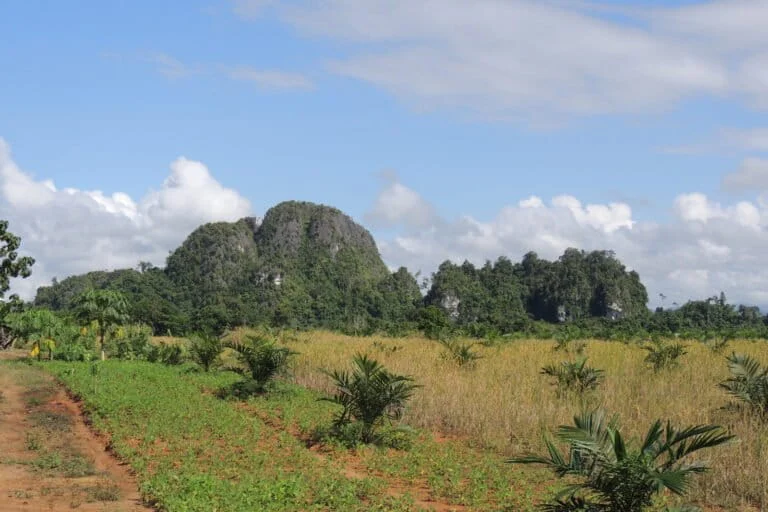
The expansion of industrial oil palm plantations is posing an existential threat to 348 rock art paintings, estimated to be approximately 2,000 years old, located across nine karst caves in the Meratus Mountains of Dukuhrejo Village, Mantewe District, Tanah Bumbu Regency, South Kalimantan. These ancient galleries, described by the National Research and Innovation Agency (BRIN) as the "oldest scriptures" of Kalimantan, represent a critical link to the island’s prehistoric past, etched onto cave walls rather than paper. The collection includes a diverse array of motifs: 14 anthropomorphic figures in the "kangkang" (splayed) position acting as symbols to ward off evil, six "spirit boats" designed to ferry the deceased to the afterlife, a one-meter-long crocodile serving as a river guardian, and mysterious three-fingered handprints adorning the ceilings of burial chambers.
Archaeologists and researchers warn that these sites are not merely remnants of a dead culture but serve as a "living document" and an "ancestral identity card" for the Dayak Meratus people. Bambang Sugiyanto, a senior researcher at BRIN’s Prehistoric and Historical Archaeology Research Center, emphasizes that the significance of the Mantewe rock art lies in its direct continuity with the contemporary traditions of the Dayak Meratus. For instance, the depiction of spirit boats aligns with modern-day rituals where replicas are used to guide souls toward Gunung Lumut. Similarly, the crocodile motifs reflect the enduring myth of the "Yellow Crocodile" (Buaya Kuning), a spiritual protector of the river. To this day, local communities maintain a taboo against killing crocodiles, believing that harming the river’s guardians will bring catastrophe to the village. Furthermore, the human figures in the paintings mirror the movements of the Tari Babat, a ritual dance performed by balian (traditional healers) to repel misfortune.
The Industrial Siege of Prehistoric Archives
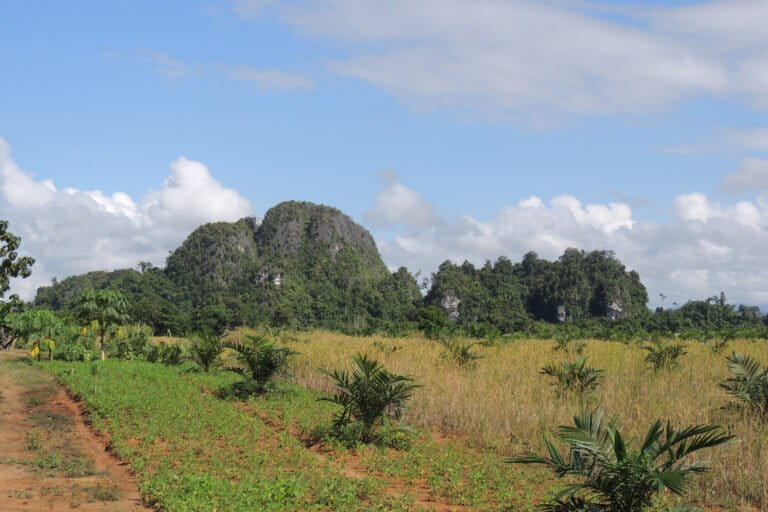
Despite their immense historical and cultural value, the caves of Mantewe are currently under siege by the encroaching palm oil industry. A comprehensive audit conducted in 2024 revealed a harrowing statistic: approximately 79% of the rock art panels are in critical condition. The paintings are suffering from peeling, the growth of invasive moss, and significant fading. The environmental stressors driving this decay are directly linked to the transformation of the surrounding landscape into monoculture plantations.
The biological reach of oil palm trees extends far beneath the surface. Bambang Sugiyanto notes that oil palm roots can penetrate the soil to a depth of three meters. This poses a direct physical threat to prehistoric burial sites, such as those found in Liang Bangkai 10, where ancient remains are interred just one meter below the surface. Beyond physical encroachment, the removal of natural forest cover to make way for plantations has fundamentally altered the microclimate within the karst systems. The rock art, primarily composed of charcoal-based pigments, is extremely sensitive to fluctuations in humidity. If the cave environment becomes too dry, the charcoal flakes and peels away; conversely, excessive humidity—often exacerbated by the loss of the forest’s natural buffering capacity—accelerates the growth of microorganisms and moss that consume the pigments.
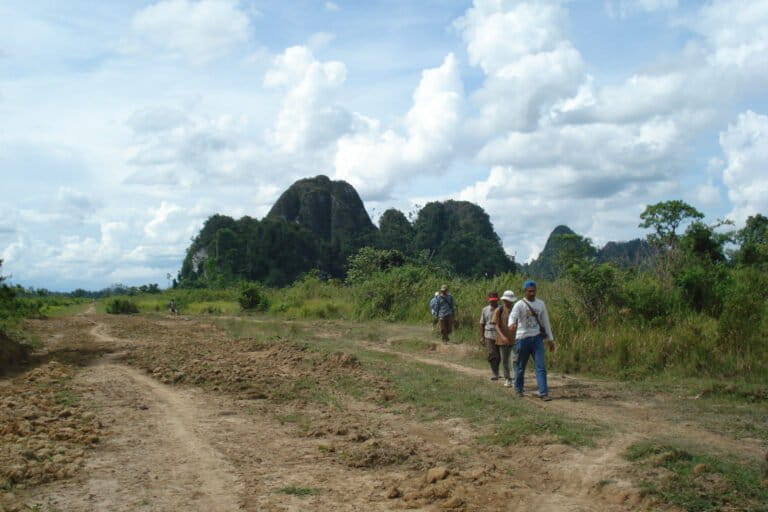
Furthermore, the chemical footprint of industrial agriculture introduces a new layer of degradation. Rainwater runoff, carrying high concentrations of synthetic fertilizers and pesticides from nearby plantations, seeps through the porous limestone of the karst. These chemicals accelerate the chemical weathering of the cave walls, leading to the rapid exfoliation of the rock surfaces upon which the 2,000-year-old "scriptures" are written. Researchers warn that if current trends continue, the 2026 planting season could result in a "mass burial" of these 348 ancestral images.
Legal Protections and Corporate Responsibility
The ongoing degradation of the Mantewe sites raises significant legal and ethical questions regarding heritage conservation in Indonesia. Under Law No. 11/2010 on Cultural Heritage, the destruction of registered or potential cultural heritage objects is a criminal offense, carrying penalties of up to five years in prison. Moreover, the principles of the Roundtable on Sustainable Palm Oil (RSPO), specifically Principle 7.12, mandate that certified companies must identify and protect sites of high cultural and heritage value.
The proximity of these plantations to the karst caves suggests a potential failure in land-use planning and environmental impact assessments. To mitigate further loss, BRIN has urged local and regional governments to take immediate legislative action. This includes the issuance of a Village Head Decree (Surat Keputusan Kepala Desa) to provide an initial legal umbrella for the Liang Bangkai area, followed by the drafting of a Regional Regulation (Peraturan Daerah) by the Tanah Bumbu Regency and the Regional House of Representatives (DPRD). Such a regulation would establish the Liang Bangkai cultural corridor as a core conservation zone, strictly off-limits to mining and plantation activities.
Physical interventions are also being proposed. Experts suggest the construction of a 1.2-kilometer wire fence to encircle a 5.12-hectare core zone. Funding for such projects could be sourced from Corporate Social Responsibility (CSR) programs of the very companies operating in the vicinity, creating a mechanism for restorative justice.
South Kalimantan as a Crossroads of Human Migration
The importance of the Mantewe caves extends beyond local heritage; they are vital to reconstructing the broader narrative of human migration in Southeast Asia. Harry Widianto, a senior paleoanthropologist, explains that South Kalimantan occupies a strategic position in the dispersal of ancient populations across the Indonesian archipelago. The region showcases a complex "stratification of cultures," where the remains and artifacts of Australomelanesoid and Austronesian populations overlap.
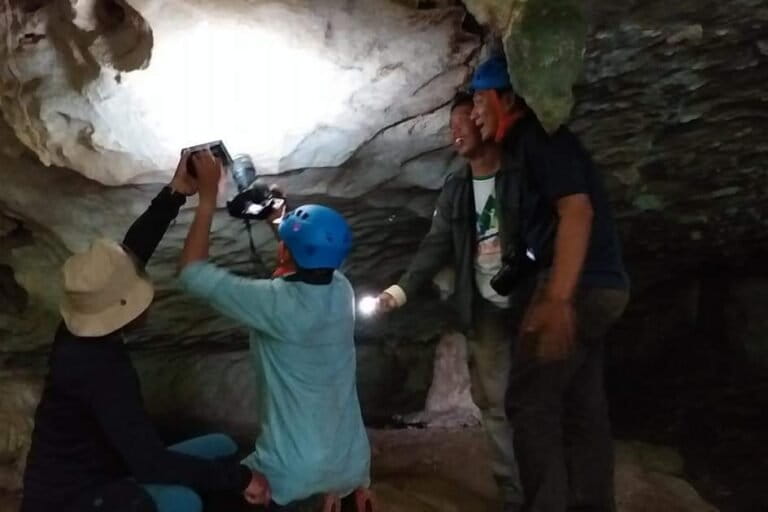
Current archaeological data suggests that Austronesian groups migrated from Taiwan via an eastern route, entering Kalimantan through Tanjung Mangkalihat before branching out toward South Sulawesi and eventually Polynesia. The findings in Mantewe, particularly the charcoal drawings, share striking similarities with motifs found at the Gua Kaung-Dalu site in West Kalimantan. This suggests the existence of a widespread cultural network or a "Borneo Black Corridor" that flourished 2,000 years ago.
The discovery of Mongoloid skeletal remains in the same cultural corridor as the rock art further enriches the genetic and cultural tapestry of the region. The Liang Bangkai 10 site, which contains human remains, coupled with the primary art gallery at Liang Bangkai 1, confirms that these caves were not temporary shelters. Instead, they were sites of permanent habitation, ritual centers, and final resting places. "In Southeast Asia, a site that offers the ‘triple package’ of rock art, human burials, and a ritual corridor is only found in Mantewe," says Sugiyanto.
Economic Potential: From Extraction to Ecotourism
While the immediate threat is industrial, the long-term solution may lie in a shift toward a sustainable heritage economy. If managed with the same rigor as the Leang-Leang prehistoric park in South Sulawesi, the Mantewe karst corridor has the potential to become a world-class ecotourism destination. Researchers estimate that the site could attract at least 100 visitors per day. With a modest entrance fee of Rp25,000, the site could generate approximately Rp75 million per month in direct revenue, not including the secondary economic benefits for the local community.
The transition to ecotourism would offer an alternative to the extractive industries that currently dominate the region. It would create specialized jobs for local youth as heritage guides and encourage the development of homestays and local craft industries. By 2030, there is a push to nominate Mantewe as a National Cultural Heritage site and eventually pursue a serial UNESCO World Heritage nomination alongside West Kalimantan’s sites under the "Borneo Black Corridor" banner.
Such a designation would transform Tanah Bumbu’s global identity. Rather than being known solely for its coal mines and palm oil, the regency could be recognized as a guardian of one of the world’s oldest artistic traditions. However, this vision requires immediate intervention. The current trajectory suggests that without a moratorium on plantation expansion near the caves and a concerted effort to stabilize the microclimate, the "KTP of the ancestors" will be erased by the very industries meant to bring prosperity to the region.
A Call for Ancestral Stewardship
The preservation of the Mantewe rock art is a race against time and the elements. The 2024 audit serves as a final warning for policymakers. The community is being encouraged to take an active role in this stewardship by forming youth patrols for routine monitoring and installing traditional "adat" signage to mark the boundaries of the sacred sites. Integrating the stories of the Buaya Kuning and the ancient paintings into local school curricula is also seen as essential for fostering a sense of ownership among the younger generation.
As the 2026 planting season approaches, the choice for the provincial government and the private sector is clear: prioritize short-term agricultural yields or protect a 2,000-year-old archive that defines the identity of the Meratus people. As Bambang Sugiyanto poignantly concluded, the failure to act now would mean that in ten years, the people of South Kalimantan will have nothing to show their children but stories of a destroyed civilization. The "scriptures" on the walls of Mantewe are not just art; they are the enduring voice of the past, currently being silenced by the rustle of oil palm fronds.