Nila Kartika Wati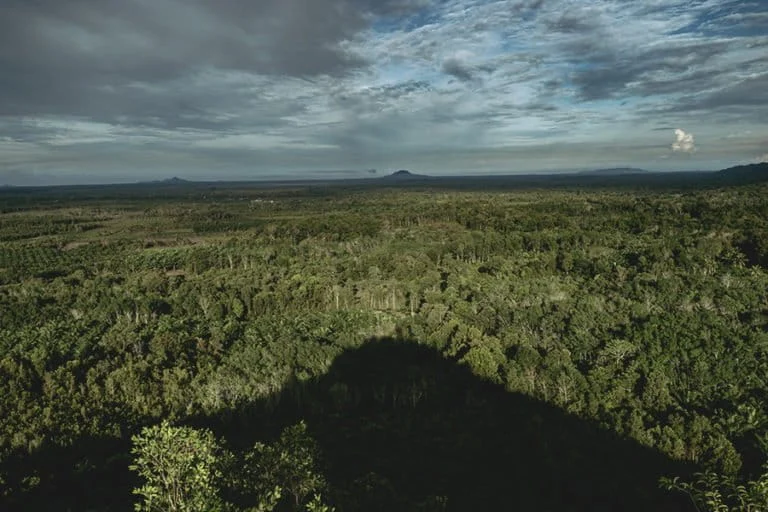
The landscape of Bangka Island, an expanse of approximately 1.1 million hectares in the Indonesian archipelago, has been fundamentally altered by centuries of intensive resource extraction and the aggressive expansion of monoculture plantations. Once a lush tropical haven, the island’s topography is now defined by vast "lunar landscapes" of abandoned mining pits and endless rows of oil palms, leaving only the granite-peaked hills as the final remnants of its original forest cover. Amidst this environmental degradation, a fragile line of defense remains: the indigenous communities and traditional shamans, known locally as dukun kampung, who continue to safeguard these hills through sacred rituals and ancestral laws. These spiritual guardians view the preservation of the highlands not merely as an ecological necessity but as a spiritual mandate, asserting that the survival of the forest is inextricably linked to the survival of the human soul and the balance of the natural world.
The historical trajectory of Bangka Island is deeply intertwined with the global demand for tin. Since the 18th century, during the era of the Palembang Sultanate and later under Dutch colonial rule, Bangka has been one of the world’s primary sources of tin. This long-standing industrial heritage has come at a staggering cost. By the late 20th century, the extraction intensified with the introduction of heavy machinery and, more recently, the proliferation of "Tambang Inkonvensional" (unconventional or illegal mining). Following the mining boom, the 1990s saw a massive shift in land use as primary forests were cleared to make way for oil palm plantations. This dual pressure has squeezed the island’s biodiversity into isolated pockets, primarily the steep, granite-rich hills that are difficult to mine or plant.
In West Bangka Regency, the Jerieng tribe of Pelangas Village maintains a deep spiritual connection to Bukit Penyabung. Standing at 300 meters, this hill is the highest point in the region and serves as the community’s most sacred site. Every year, during the Islamic month of Muharram, the tribe gathers for "taber gunung," a traditional ritual intended to express gratitude for the harvest and to seek protection from natural disasters. Janum bin Lamat, the current Head of Adat for the Jerieng tribe and a seventh-generation descendant of the "batin gunung" (mountain wardens), describes the role of the dukun kampung as a heavy burden of stewardship. According to Janum, their responsibility extends beyond the human population to include the welfare of animals and the health of the flora.
The continuity of these traditions has not been without interruption. Between 1991 and 1997, the ritual of taber gunung fell into a period of dormancy. This hiatus coincided with the rapid encroachment of large-scale palm oil plantations that began to swallow the buffer zones surrounding Bukit Penyabung. The loss of the forest appeared to signal the death of the tradition until August 2022, when Janum reportedly received a spiritual mandate through a dream from his ancestors to revive the ceremony after a 25-year absence. The revival of the ritual is seen by the community as a reclamation of their identity and a formal declaration that the remaining forest on Bukit Penyabung is under the protection of ancestral law, which forbids the destructive activities seen in the lowlands.
Further south, in Bangka Selatan, Bukit Nenek serves as a similar sanctuary. Standing 380 meters tall, the hill is the site of the "Ketupat Gong" ritual performed by the residents of Gudang Village. Makmun, a local dukun kampung, notes that while the government officially designated the area as the Gunung Permisan Nature Tourism Park (TWA) in 2016, the community had been protecting the site for generations through sacred taboos. The effectiveness of these traditional belief systems often surpasses state-enforced regulations. In areas where the dukun’s word is law, the forest remains standing; where the tradition fades, the chainsaws and excavators inevitably follow.
The spiritual hierarchy of Bangka’s hills finds its apex at Gunung Maras. Reaching an elevation of 705 meters, it is the highest peak on the island and was designated a National Park in 2016, covering over 16,800 hectares. For the indigenous Suku Maras, this mountain is the "Grandfather" of all hills on the island, acting as the primary spiritual anchor for the entire region. Umran, a seventh-generation descendant of the Maras tribe, warns that the mountain serves as a natural regulator of the island’s water cycle. He posits that the destruction of Gunung Maras would trigger catastrophic flooding, as the "Grandfather" would no longer be able to hold back the rains. Despite its protected status, Gunung Maras is under constant threat from illegal encroachment and small-scale mining. Damion, along with eight other shamans, continues to perform closed-door rituals at the summit to maintain the spiritual seal of the mountain, even as the surrounding landscape is stripped of its greenery.
The consequences of losing this spiritual stewardship are most visible in Bukit Mangkol, Central Bangka. Once a site of vibrant traditional activity, the rituals at Bukit Mangkol vanished in the 1970s. The decline was attributed to a lack of succession; as younger generations moved toward modern education and urban employment, the complex knowledge required to be a dukun kampung was not passed down. Today, the 6,000-hectare Tahura (Great Forest Park) Bukit Mangkol is a shadow of its former self, plagued by illegal logging and mining operations. Mang Kalu, a descendant of the hill’s former shamans, laments the loss of "adat" (customary law). He observes that in the absence of traditional prohibitions, there is no moral or spiritual barrier to stop individuals from exploiting the land for short-term gain.
Central to the traditional management of Bangka was the concept of "hutan riding." This term refers to a network of ecological and spiritual corridors, approximately 100 meters wide, that once connected the various villages and hills across the island. These corridors were agreed upon by the shamans of different tribes as "highways" for spiritual entities and wildlife. They ensured that even as villages grew, the island remained interconnected through a web of greenery. However, the expansion of industrial mining and monoculture has severed these links. The fragmentation of the "hutan riding" has not only disrupted the migration patterns of local fauna but has also isolated human communities from one another, leading to increased social friction and conflicts over dwindling natural resources.
Data from environmental monitoring agencies highlights the severity of the crisis. Between 2014 and 2020 alone, the Bangka Belitung Islands lost approximately 460,000 hectares of forest cover. This rapid deforestation has led to increased instances of flash flooding in the rainy season and acute water shortages during the dry season, as the island’s natural watersheds are compromised. The loss of forest cover also impacts the local climate, leading to higher average temperatures and a reduction in soil fertility for traditional farmers who do not utilize the heavy fertilizers required by palm oil plantations.
The current situation presents a complex challenge for Indonesian policymakers. While the government has established various protected statuses for these hills—ranging from National Parks to Nature Tourism Parks—the enforcement of these boundaries is often weak. In contrast, the "invisible boundaries" set by the dukun kampung have historically proven more resilient. There is a growing recognition among environmentalists and some local officials that formal conservation efforts must integrate traditional ecological knowledge (TEK). By empowering the dukun kampung and recognizing customary land rights, the state could leverage a pre-existing social infrastructure that is naturally inclined toward preservation.
The struggle on Bangka Island is a microcosm of a global tension between industrial development and indigenous conservation. The shamans of Bangka are not merely performing "superstitious" rites; they are maintaining a sophisticated system of land management that has sustained the island for centuries. Their rituals serve as a communal reminder of the limits of extraction. As Janum bin Lamat and his peers continue their prayers on the granite peaks, they are fighting for a future where Bangka is defined not by the craters of its past, but by the resilience of its sacred forests. The message from the hills is clear: the loss of tradition is the precursor to the loss of the land, and without the balance provided by the forest, the island’s residents face a precarious and uncertain future. The restoration of ritual, therefore, is not a step backward into the past, but a necessary strategy for survival in an age of ecological collapse.