Nila Kartika Wati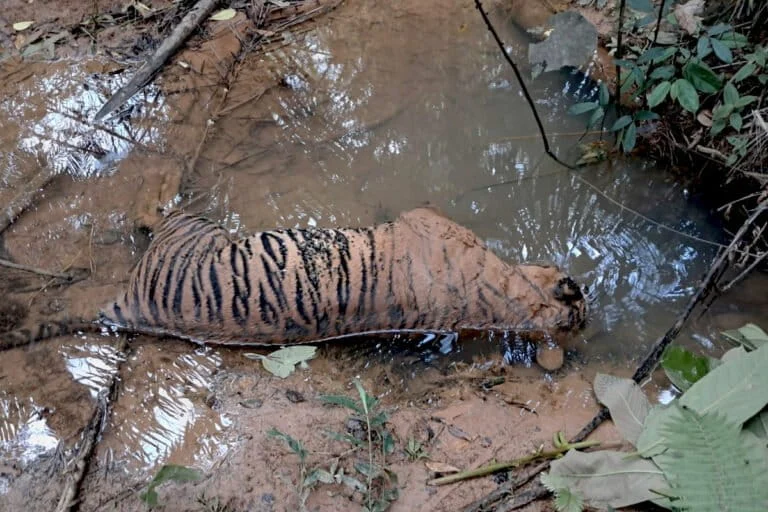
The discovery of two Sumatran elephant carcasses in the Seblat Landscape of Bengkulu on April 29, 2026, has ignited a firestorm of criticism regarding Indonesia’s forest governance and the efficacy of its conservation efforts. The deceased elephants, members of a critically endangered species, were found in a state of decomposition near the concession areas of major forestry companies. Upon closer inspection, a monitoring consortium discovered bags containing toxic substances suspended from wooden posts in the vicinity, leading investigators to conclude that the animals were victims of deliberate poisoning. This method of eradication is frequently employed by parties seeking to clear land or protect illegal oil palm plantations from the movements of megafauna that still consider these areas their ancestral corridors.
This latest incident is not an isolated tragedy but rather part of a documented pattern of violence against wildlife in the region. Since 2018, at least seven Sumatran elephants have perished within the Seblat Landscape under suspicious circumstances. The methods of killing have grown increasingly brutal; past necropsies and field reports have revealed elephants dying from gunshot wounds, ingestion of hazardous chemicals, and severe infections caused by "nail traps"—planks of wood studded with long nails buried in the ground to puncture the sensitive soles of the elephants’ feet. The carnage is not limited to pachyderms; Sumatran tigers, another critically endangered species, have also been found dead within the concession boundaries of companies operating in the area, highlighting a broader collapse of biodiversity safety nets.
Government Intervention and the Revocation of Licenses
In a direct response to the outcry from environmental advocates and the mounting evidence of negligence, the Minister of Forestry, Raja Juli Anton, convened a press conference on May 7, 2026. The Minister announced a decisive move to revoke the Forest Utilization Business Licenses (PBPH) of two major entities: PT Bentara Arga Timber (BAT) and PT Anugerah Pratama Inspirasi (API). These companies had already seen their operations frozen in 2025 following initial reports of environmental mismanagement. At that time, the government had imposed a mandate for ecosystem restoration, requiring the firms to rehabilitate the degraded land they occupied.
However, subsequent investigations revealed that instead of restoring the forest, the concession areas had become hotbeds for illegal activity. Field audits and satellite monitoring identified extensive illegal logging and the unauthorized planting of oil palm within the zones designated for recovery. Minister Raja Juli Anton emphasized that administrative sanctions would no longer suffice in the face of such blatant defiance of the law. He stated that the government would pursue criminal charges against the management of these companies, signaling a shift toward more aggressive enforcement. The Ministry’s stance is that corporate actors must be held legally accountable for the deaths of protected species occurring within their jurisdictions, especially when those areas are being illicitly converted for commercial gain.
Critical Delays and the Scepticism of Conservationists
Despite the government’s firm rhetoric, the conservation community remains wary. Egi Ade Saputra, the Executive Director of the Genesis Bengkulu Foundation, noted that the Minister’s pronouncements, while welcome, are significantly overdue. For years, activists have provided the government with data showing that the Seblat Landscape was being hollowed out from within. Saputra argued that "statements of intent" have been heard before, but they rarely translate into immediate on-the-ground protection. The foundation has called for the immediate publication and public dissemination of the formal Decree of Revocation (SK Pencabutan) to ensure that the land is legally reclaimed and protected from further exploitation.
The skepticism is rooted in a history of "revolving door" concessions, where a license is revoked from one company only to be granted to another under a different name, or left in a legal vacuum where illegal actors move in even faster. Without a change in the legal status of the land itself, the removal of PT BAT and PT API might simply create a vacuum for other opportunistic entities.
Satellite Data Reveals a Landscape in Freefall
The scale of the destruction in the Seblat Landscape is quantified by harrowing data. An analysis of Landsat 8 satellite imagery conducted by the Genesis Foundation between February and April 2026 shows that land clearing has accelerated despite the "frozen" status of the concessions. In February 2026 alone, analysts identified 307 distinct points of land clearing, totaling more than 2,000 hectares of forest loss. Over the past two years, the Seblat Landscape—often described as the last stronghold for elephants in the province—has lost approximately 6,800 hectares of its primary forest cover.
This rapid deforestation is driven largely by the high demand for palm oil and the lack of physical barriers or active patrolling in the concessions. When the forest canopy is removed, the remaining habitat becomes fragmented, forcing elephant herds into closer proximity to human settlements and agricultural plots. This proximity inevitably leads to "human-wildlife conflict," a term that conservationists argue is often a misnomer for the systematic displacement and killing of animals to make way for industry.
The Fragmentation of Habitat Pockets
Wishnu Sukmantoro of the Indonesian Elephant Conservation Forum (FKGI) highlighted that the crisis has moved beyond the death of individual animals to a structural collapse of the ecosystem. The Seblat Landscape covers approximately 112,000 hectares, but more than 30,000 hectares are now classified as severely degraded or entirely converted. Historically, this landscape supported four distinct "habitat pockets"—areas where elephant populations could feed, breed, and migrate.
Today, only three of those pockets remain, and even those are under extreme pressure. One habitat pocket has been entirely erased, replaced by a monoculture of oil palm. Sukmantoro pointed out that the survival of the Sumatran elephant depends on "landscape connectivity." Elephants are migratory animals that require vast ranges to maintain genetic diversity and find seasonal food sources. When these corridors are severed by plantations or roads, the population becomes isolated, leading to inbreeding and increased vulnerability to poaching or poisoning. The loss of a single pocket can destabilize the entire regional population.
The Global Context of the Sumatran Elephant
The Sumatran elephant (Elephas maximus sumatranus) is currently listed as Critically Endangered on the IUCN Red List, just one step away from being extinct in the wild. The species has lost nearly 70% of its habitat and half of its population in just one generation. Nationwide, the situation is equally dire. Of the 42 habitat pockets that were documented across Sumatra in previous decades, only 21 remain viable today. The Seblat Landscape is one of the few remaining areas in the southern part of the island where a wild population still exists, making its preservation a matter of national and international importance.
The decline of the elephant is also an indicator of the health of the broader ecosystem. As a "keystone species," elephants play a vital role in seed dispersal and maintaining the structure of the forest. Their disappearance signals a wider environmental collapse that affects water cycles, local climates, and the survival of countless other species, including the Sumatran tiger and various endemic flora.
A Call for a Wildlife Sanctuary Status
In light of the systemic failure of the concession system, the Seblat Landscape Conservation Consortium is pushing for a fundamental change in the area’s legal status. They are advocating for the 112,000-hectare area to be reclassified as a Wildlife Sanctuary (Suaka Margasatwa). Unlike "Production Forests" or "Restoration Concessions," a Wildlife Sanctuary status would provide the highest level of legal protection, strictly prohibiting any form of commercial extraction or land conversion.
Ali Akbar from Kanopi Hijau Indonesia expressed concern that the revocation of licenses for PT BAT and PT API might be a cosmetic fix. There are reports that other corporate interests are already eyeing the Seblat area for new concessions. Akbar warned that without a permanent change to a protected status, the cycle of destruction will simply repeat with new corporate players. The transition to a Wildlife Sanctuary would effectively close the door to the "business-as-usual" approach that has dominated Bengkulu’s forestry sector for decades.
Implications for Future Forestry Governance
The deaths of the two elephants in April 2026 serve as a grim reminder of the consequences of weak oversight and a centralized management system that often feels disconnected from the realities on the ground. The Seblat case demonstrates that even when companies are under government scrutiny (such as during a license freeze), they can continue to facilitate or ignore illegal activities within their boundaries.
The proposed criminal prosecution of corporate executives marks a potential turning point in Indonesian environmental law. If successful, it would set a precedent that companies are legally responsible for the "duty of care" toward protected wildlife on their land. However, the path to a conviction is fraught with challenges, including the need for forensic evidence linking corporate negligence to the specific acts of poisoning or trapping.
As the Seblat Landscape continues to be eroded by illegal interests and corporate apathy, the window for saving the Sumatran elephant in Bengkulu is rapidly closing. The loss of seven elephants in eight years in a single landscape is a statistical anomaly that points to an intentional effort to clear the way for industry. For the conservationists on the front lines, the question is no longer whether the government recognizes the problem, but whether it possesses the political will to prioritize a critically endangered species over the lucrative returns of the palm oil and timber industries. Without immediate, transparent, and permanent legal protections, the Seblat Landscape risks becoming a graveyard for a species that has roamed the forests of Sumatra for millennia.