Nasution Nanang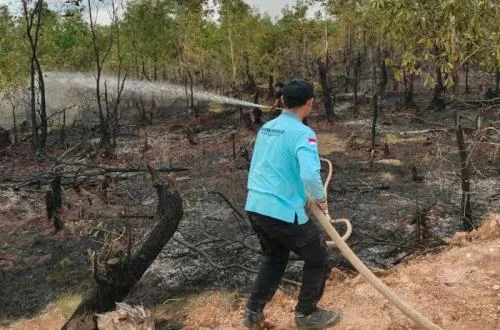
The National Disaster Management Agency (BNPB) has officially confirmed that a dedicated joint task force is relentlessly intensifying its efforts to suppress and contain land fires that have ravaged approximately 5.3 hectares of open land in Banjar Regency, South Kalimantan. This significant incident of forest and land fires (Karhutla) in the region began simultaneously across two distinct villages on Saturday, June 20th, marking a concerning start to what authorities anticipate could be a challenging dry season. The coordinated response underscores the government’s commitment to mitigating the environmental and public health risks posed by such widespread conflagrations, particularly in areas prone to recurring fire outbreaks.
Escalating Crisis in Banjar: A Detailed Chronology
The alarm was first raised on Saturday, June 20th, when multiple fire points were detected concurrently in two separate administrative areas within Banjar Regency. The rapid spread of the flames quickly prompted an emergency response. Abdul Muhari, the Head of the Data, Information, and Communication Centre for Disaster at BNPB, articulated the immediate actions taken. Upon receiving reports, the Regional Disaster Management Agency (BPBD) of Banjar Regency, in conjunction with a multi-agency joint team comprising various emergency response elements, was swiftly dispatched to the affected locales. Their primary mandate was to initiate immediate fire suppression activities and localize the hotspots to prevent further expansion.
A rapid assessment conducted on the ground by the responding teams revealed the extent of the devastation. The inferno had consumed vegetation across two distinct sub-districts, impacting a total area of 5.3 hectares. Specifically, the assessment indicated that two hectares of land were scorched in Desa Simpang Lima, located within the Cintapuri Darussalam sub-district. Concurrently, a more extensive area, approximately 3.3 hectares, was engulfed in flames in Desa Pesayangan, situated in the Martapura sub-district. The simultaneous nature of these outbreaks presented a significant challenge for the emergency responders, requiring a coordinated deployment of resources across multiple fronts.
By Monday, the situation saw partial resolution and continued intensive efforts. Abdul Muhari provided an update from Jakarta, confirming significant progress in one of the affected areas. "For the hotspot in Desa Simpang Lima, it has been fully extinguished," Muhari stated, highlighting the success of the concentrated efforts in that particular zone. However, he also acknowledged the ongoing struggle in the adjacent area, adding, "However, for the land in Desa Pesayangan, the suppression process is still underway." This update underscored the dynamic nature of the firefighting operations, where varying terrain, wind conditions, and the type of vegetation can dictate the speed and difficulty of extinguishing the flames. The teams in Pesayangan continued to battle the blaze, employing various techniques to bring the remaining hotspots under control and prevent any potential re-ignition.
The Persistent Threat of Karhutla in Kalimantan
The incidence of land fires in Banjar is not an isolated event but rather a recurring environmental crisis that plagues Indonesia, particularly the vast island of Kalimantan, during the annual dry season. Known locally as Karhutla (Kebakaran Hutan dan Lahan), these forest and land fires have profound and far-reaching consequences. South Kalimantan, with its extensive peatlands and agricultural areas, is particularly vulnerable and frequently emerges as a hotspot for such conflagrations.
The root causes of Karhutla are multifaceted, often stemming from a combination of human activities and natural conditions. A predominant factor is the practice of land clearing through burning, widely employed by farmers and plantation companies for agricultural purposes or preparing land for new crops. While seemingly efficient and cost-effective in the short term, this method carries immense risks, especially when conducted during dry periods. Other human-induced causes include accidental fires, discarded cigarette butts, and illegal logging activities that leave behind highly flammable debris. Natural factors, though less frequent as primary ignition sources, play a crucial role in exacerbating fires. Prolonged dry spells, often intensified by climatic phenomena such as El Niño, create highly combustible conditions, turning vast tracts of land into tinderboxes. Peatlands, which are abundant in Kalimantan, pose a unique challenge. Once ignited, peat fires can burn deep underground for weeks or even months, emitting vast quantities of smoke and carbon and proving exceptionally difficult to extinguish. The burning of peat, a carbon-rich organic soil, releases substantial greenhouse gases, contributing significantly to global climate change.
Multi-Agency Response and Strategic Operations
The "tim gabungan," or joint team, deployed to Banjar Regency represents a comprehensive, multi-agency approach characteristic of Indonesia’s disaster response framework. This collaborative force typically comprises personnel from various governmental and non-governmental entities, each bringing specialized expertise and resources to the table. Key components of such a team include the local BPBD, which leads disaster coordination; the Indonesian National Armed Forces (TNI) and the Indonesian National Police (Polri), providing manpower, logistical support, and security; Manggala Agni, the Ministry of Environment and Forestry’s dedicated forest fire management brigade, renowned for its specialized firefighting techniques; and various local community groups and volunteers who possess invaluable local knowledge and act as first responders.
The strategies employed in combating these fires are often multifaceted. Ground teams engage in direct attack, utilizing water hoses, fire beaters, and creating fire breaks to contain the spread. For larger or more inaccessible fires, aerial support, including water-bombing helicopters, is often deployed to douse flames from above. The effectiveness of these operations is heavily dependent on factors such as terrain, wind direction, and the type of burning material. Peat fires, for instance, necessitate a different approach due to their deep-seated nature, often requiring saturation of the soil over extended periods to ensure complete extinguishment and prevent re-ignition. The challenge is further compounded by logistical hurdles in reaching remote fire locations and ensuring a continuous supply of water. Modern technology, including satellite monitoring and drone surveillance, plays an increasingly vital role in identifying hotspots early, tracking fire progression, and guiding response teams to critical areas.
BNPB’s Urgent Appeals and Prevention Directives
In light of the escalating number of fire incidents and the onset of the dry season, BNPB has issued an urgent appeal to regional authorities and communities across South Kalimantan to bolster their emergency oversight and preventive measures. Abdul Muhari emphasized the critical need for heightened vigilance and proactive engagement to avert more severe outbreaks. A core component of this appeal is the call for increased ground patrols, particularly in areas identified as high-risk or prone to previous fire incidents. These patrols serve as an early detection mechanism, allowing for swift intervention before small fires can escalate into uncontrollable infernos.
Furthermore, BNPB has specifically cautioned all stakeholders against any form of land clearing by burning. This traditional practice, deeply entrenched in some agricultural communities, is identified as a primary trigger for large-scale fires. The agency underscored the inherent risks associated with such practices, noting that fires ignited for land clearing purposes can rapidly spread beyond their intended boundaries, especially under dry and windy conditions. Once uncontrolled, these fires become exceedingly difficult to manage, posing significant threats to human lives, property, and the environment. The directive serves as a reminder of existing laws and regulations prohibiting illegal burning and highlights the collective responsibility to adopt safer, more sustainable land management techniques. The focus on prevention is paramount, as extinguishing large-scale Karhutla events consumes immense resources and often causes irreparable damage.
Broader Environmental and Socio-Economic Ramifications
The impact of Karhutla extends far beyond the immediate charred landscapes, precipitating a cascade of environmental, health, and socio-economic crises. Environmentally, the destruction of forests and peatlands leads to significant biodiversity loss, as countless species lose their habitats. The release of massive amounts of carbon dioxide and other greenhouse gases from burning vegetation and peat contributes substantially to climate change, undermining global efforts to reduce emissions. Moreover, the thick haze generated by these fires often blankets entire regions, sometimes crossing national borders, leading to transboundary haze crises that affect neighboring countries like Malaysia and Singapore.
From a public health perspective, the haze contains fine particulate matter (PM2.5) and other toxic pollutants, causing a surge in acute respiratory infections (ARI) and exacerbating chronic respiratory and cardiovascular conditions among affected populations. Children and the elderly are particularly vulnerable, often requiring mass evacuations or access to emergency medical care. Economically, the fires cause extensive damage to agricultural lands and plantations, leading to significant crop losses and impacting the livelihoods of local communities dependent on farming. Transportation, particularly air travel, is frequently disrupted due to poor visibility, incurring substantial economic costs and inconveniencing countless travelers. The recurrent nature of these disasters also deters investment and tourism, stifling regional economic development. Banjar Regency, with its mixed landscape of agricultural plots and peat swamp forests, is particularly susceptible to these multifaceted impacts, making effective fire management crucial for its long-term stability and prosperity.
Towards Sustainable Solutions and Enhanced Preparedness
Addressing the persistent challenge of Karhutla in Indonesia requires a multi-pronged approach encompassing robust law enforcement, sustainable land management practices, and significant community engagement. National strategies are increasingly focused on peatland restoration and rewetting initiatives, aiming to increase moisture levels in these highly flammable ecosystems and reduce their susceptibility to fire. Strict enforcement of anti-burning laws and regulations is vital, coupled with punitive measures for those who illegally clear land using fire. Furthermore, promoting alternative, fire-free land clearing methods among farmers and plantation companies is essential, requiring education, technical assistance, and financial incentives.
Investment in advanced early detection and rapid response infrastructure is also paramount. This includes expanding satellite monitoring capabilities, deploying more ground sensors, and establishing well-equipped fire brigades with trained personnel and modern firefighting equipment. Community empowerment programs are critical, engaging local residents in fire prevention efforts, providing them with training, and integrating traditional knowledge with modern techniques. The government’s long-term commitment is to achieve a "zero haze" policy, demonstrating a resolve to eliminate the annual haze crisis. This ambitious goal necessitates continuous collaboration between various government agencies, local communities, the private sector, and international partners. Sustainable solutions are not merely about extinguishing fires but about fundamentally altering land use practices and fostering a culture of environmental stewardship that prevents fires from igniting in the first place.
The ongoing efforts in Banjar Regency underscore the continuous battle against land fires that Indonesia faces annually. While the success in extinguishing the fire in Desa Simpang Lima offers a glimmer of hope, the persistent blaze in Desa Pesayangan serves as a stark reminder of the challenges ahead. The collective responsibility of authorities, communities, and industries to prevent future outbreaks is paramount as the dry season intensifies, demanding sustained vigilance, proactive measures, and a commitment to sustainable environmental practices to protect South Kalimantan’s natural heritage and the well-being of its people.