
 Nila Kartika Wati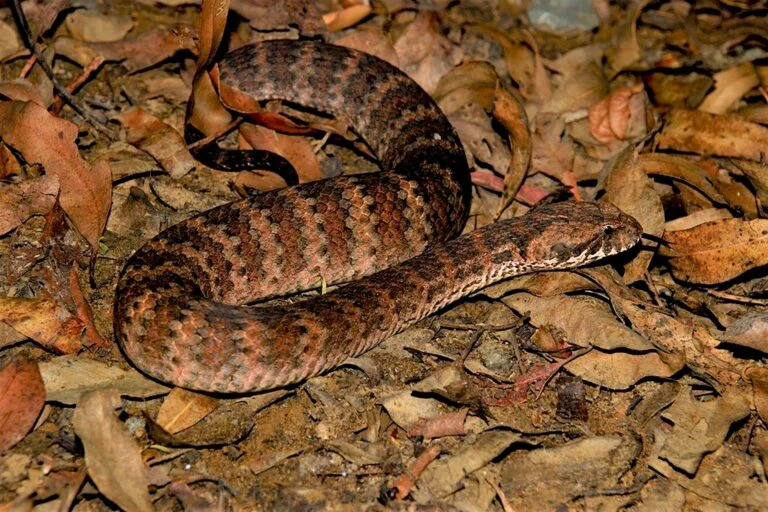
Deep within the damp, decaying leaf litter of Papua’s dense tropical forests, a lethal predator lies in wait. It is a creature of stillness, possessing a unique morphology that allows it to vanish into its surroundings with chilling efficiency. Clad in intricate patterns of rust, chocolate, and obsidian, the Death Adder—locally dubbed the "stupid snake"—is anything but dim-witted. While its sedentary nature earns it a reputation for lethargy among local inhabitants, this behavior is, in reality, a highly evolved evolutionary strategy that makes it one of the most formidable ambush predators in the Australasian region.
The Myth of the Stupid Snake
The moniker "ular bodoh" or "stupid snake" stems from a distinct behavioral trait: its refusal to flee when approached. Hari Suroto, a researcher at the National Research and Innovation Agency (BRIN) Center for Environmental Archaeology, notes that even when prodded with sticks or disturbed by human presence, the snake often remains perfectly motionless.
"When found in grasslands or humid environments, this species remains static," Suroto explains. "Even when we touch it with a wooden stick or another object, it chooses to stay still. That is the reason it is called the stupid snake."
However, this lack of movement is not a sign of cognitive deficiency; it is a tactical choice. The Death Adder (genus Acanthophis) belongs to the Elapidae family, placing it in the same biological lineage as cobras and kraits. Unlike active hunters that patrol the forest floor, the Death Adder is an ambush specialist. By remaining stationary, it minimizes its energy expenditure while maximizing its camouflage, turning itself into a living trap for unsuspecting prey.
Morphology and Evolutionary Tactics
The Death Adder’s physical structure is uniquely adapted to its sedentary lifestyle. Unlike the slender, elongated bodies of many other snakes, the Acanthophis species possesses a short, thick, and stocky frame, typically measuring between 40 and 70 centimeters. Its head is notably broad and triangular, often described as axe-shaped, housing a pair of vertical pupils and remarkably long fangs that deliver potent neurotoxic venom.
Perhaps its most sophisticated hunting tool is its tail. The tip of the tail is modified to resemble a small worm or grub. By twitching this appendage—a process known as caudal luring—the snake mimics the movement of invertebrate prey. When small mammals, lizards, or frogs approach the "worm" to investigate, they enter the strike zone. The Death Adder’s strike is a blur of motion, capable of executing a lunge and venom delivery in less than 0.13 seconds, a speed that places it among the fastest striking snakes in the world.
The Human Toll and Safety Concerns
The very traits that make the Death Adder a successful predator—its stillness and reliance on camouflage—create a significant danger for humans. Because it does not retreat, it is frequently stepped upon by hikers, laborers, and forest dwellers who fail to detect it until it is too late.
The consequences of such encounters can be fatal. In 2019, a tragic incident in Timika, Papua, saw a member of the Brimob (Mobile Brigade Corps) succumb to a bite from a Death Adder. This event served as a sobering reminder of the lethal risk posed by the species to those working in the Papuan interior.
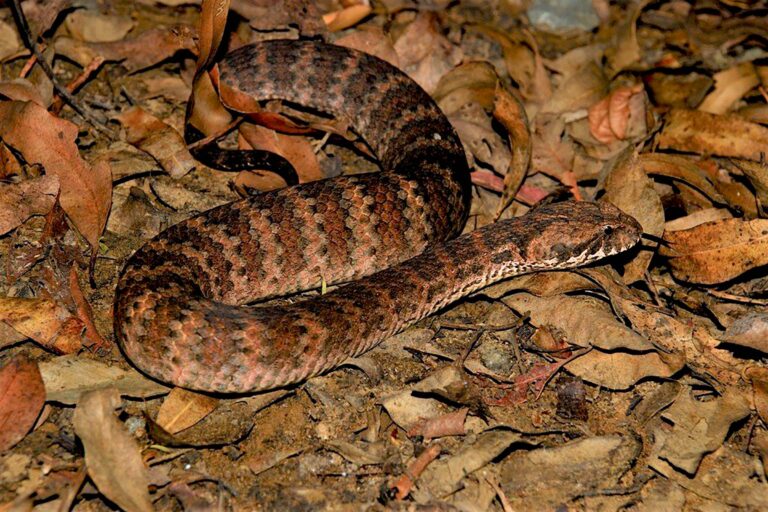
Local wisdom has evolved to address this threat. Residents frequently employ a cautionary system when traversing the forest. When a Death Adder is spotted, observers will often quietly signal to their companions by calling out the word "tali" (rope). This code warns the group to remain calm, avoid sudden movements, and carefully inspect the path ahead without inciting a defensive strike from the snake.
Biological Context and Global Comparison
The Acanthophis genus is distributed across a wide range of habitats, from the arid deserts of Australia to the lush, humid rainforests of Papua and Indonesia. While the Acanthophis antarcticus is the most well-known species in Australia, the variations found in Papua are equally potent.
The toxicity of Death Adder venom is significant. As an elapid, the snake utilizes a potent neurotoxin that disrupts the transmission of nerve impulses, leading to respiratory failure and paralysis. Unlike many vipers that cause extensive tissue necrosis, the primary danger of a Death Adder bite is the rapid onset of systemic failure. Because of the snake’s tendency to remain stationary even when humans are in immediate proximity, the likelihood of a "dry bite" or a warning strike is lower than that of more aggressive, mobile species; when a Death Adder does bite, it is often a full, high-venom-volume defensive strike.
Environmental Implications and Coexistence
The "stupid snake" moniker serves as a psychological buffer for local populations, allowing them to characterize a terrifying predator as something benign or foolish. However, experts like Hari Suroto emphasize the need for a shift in perception. Treating the snake as "stupid" invites carelessness, which is the primary cause of envenomation.
From an ecological perspective, the Death Adder is a critical component of the forest food web. By keeping small mammal and reptile populations in check, it maintains a delicate balance within the ecosystem. Its survival is intrinsically linked to the health of the leaf litter and the forest floor, which are increasingly threatened by deforestation and agricultural expansion.
As human activity continues to penetrate deeper into the remote regions of Papua, the frequency of human-snake encounters is likely to increase. Public safety initiatives, including the distribution of accurate identification guides and the establishment of more accessible antivenom supplies in remote clinics, are becoming increasingly vital.
Conclusion: Respecting the Master of Stillness
The Death Adder remains one of nature’s most effective examples of evolutionary refinement. To view it as "stupid" is to fundamentally misunderstand the nature of survival in the rainforest. Its brilliance lies in its patience and its ability to turn the environment into an extension of its own hunting apparatus.
For the people of Papua, the lesson is clear: the most dangerous threats in the forest are often those that are least visible. By recognizing the Death Adder’s role as an ambush predator rather than a clumsy obstacle, residents can better navigate the landscape. The snake does not hunt humans, but it will defend its space with lethal speed when encroached upon. Moving forward, education remains the most effective tool in preventing further loss of life, turning a landscape of potential terror into one of informed, cautious coexistence.
As researchers continue to study the behavioral ecology of Acanthophis, the goal remains twofold: to unlock the secrets of its unique predatory mechanisms and to ensure that human communities possess the knowledge necessary to avoid the lethal precision of a creature that, despite its name, is perfectly adapted for the life it leads.









