
 Nila Kartika Wati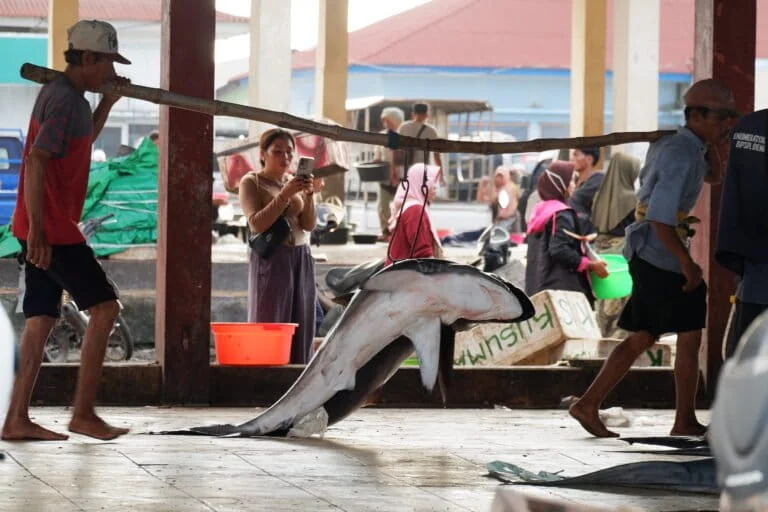
Alimuddin begins his morning not by casting heavy nets into the deep blue, but by scanning the horizon of Tanjung Luar beach in East Lombok, waiting for his turn to ferry tourists across the shimmering waters. For nearly two decades, Alimuddin’s life was defined by the grueling, high-stakes trade of shark fishing. Today, that narrative has shifted. Since 2016, he has transitioned into the role of a marine tourism guide—a move prompted by the stark realization that the physical danger and long, lonely weeks at sea were no longer justified by the diminishing financial returns. "Catching sharks is simply not worth the risk," he says, reflecting on years spent battling the elements and the inherent perils of industrial-scale shark harvesting.
This shift is not unique to Alimuddin. It represents a burgeoning, albeit fragile, trend in coastal communities where the pressure to protect marine biodiversity collides with the harsh realities of poverty and survival. Agip, another former shark hunter, retired from the trade in 2010. After a brief stint as a traditional artisanal fisherman, he pivoted to the tourism sector. For Agip, the primary incentive was not just the potential for a stable income—ranging from IDR 150,000 to IDR 200,000 per day—but the invaluable opportunity to remain close to his family. In the shark fishing industry, weeks away from home were the norm, often resulting in social alienation and the erosion of family ties.
The Epicenter of the Shark Trade
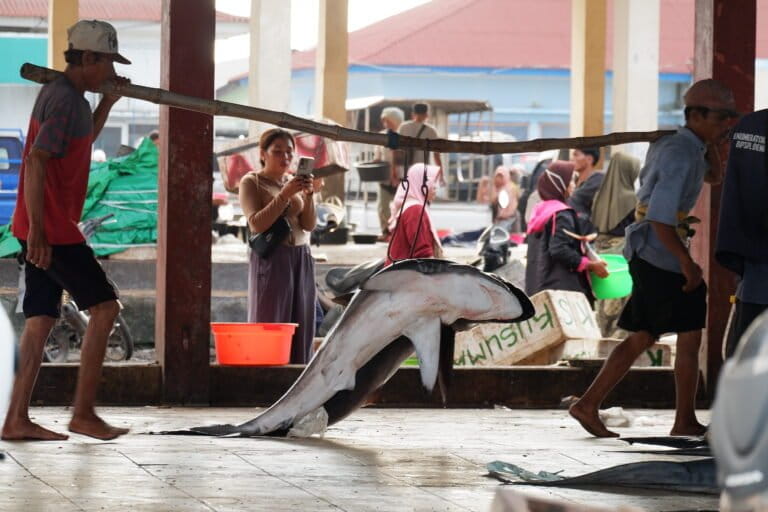
The transition stories of Alimuddin and Agip unfold against the backdrop of Tanjung Luar, one of Indonesia’s most significant landing sites for sharks and rays. The scale of the trade here is staggering. Over a two-year period of intensive monitoring, researchers documented more than 13,000 sharks and rays across 57 distinct species being brought to shore at this single location.
Despite the sheer volume of these landings, the wealth generated by this trade is rarely distributed equitably. While the global market for shark products—ranging from fins for traditional delicacies to meat and cartilage—is lucrative, the primary producers (the crew members) often operate in a state of perpetual debt. Interviews with local workers reveal a systemic cycle of financial precarity: they frequently bear the burden of high operational costs, ship maintenance, and even their own medical expenses. If a voyage fails to yield a substantial catch, the crew members often find themselves deeper in debt rather than closer to prosperity. This lack of transparency and economic security serves as the strongest argument for why conservation efforts must move beyond simple prohibitions and address the structural economic needs of the fishing community.
A Chronology of Conservation Efforts
The effort to curb shark fishing in the region has been a multi-faceted struggle spanning over a decade. Since 2007, community leaders like Muksin have been actively advocating for a transition away from shark extraction, recognizing that the ecological collapse of shark populations would eventually leave the community without any livelihood at all.
The following timeline outlines the evolution of these efforts:
- 2007: Initial advocacy for vocational shifts begins, led by local community champions, aiming to reduce the number of boats targeting sharks.
- 2010: Significant individuals, including Agip, formally exit the shark fishing industry, signaling a shift toward more sustainable, albeit modest, alternative livelihoods.
- 2016: Alimuddin transitions into the marine tourism sector, marking a broader adoption of tourism as a viable, low-impact economic alternative in East Lombok.
- 2023-2024: Yayasan Kebersamaan untuk Lautan (KUL) introduces formal compensation programs for fishermen who agree to release live sharks and rays.
- 2025: KUL moves from a compensation model to a vessel-retirement model, purchasing and decommissioning two primary shark-fishing vessels.
The Failure of Compensation and the Rise of Structural Intervention
The initial approach to conservation—providing direct monetary compensation to fishermen for releasing sharks caught as bycatch or during targeted operations—faced significant hurdles. According to M. Said Ramdlan, Secretary of KUL, the program yielded only three released sharks in its first year. Even when compensation levels were increased, the systemic pressures remained insurmountable. Fishermen were often beholden to boat owners, local collectors, and market demand, which collectively created a barrier that direct cash payments could not penetrate.
Recognizing the limitations of the compensation model, KUL pivoted to a more structural approach. By purchasing two shark-fishing vessels for IDR 300 million each and permanently decommissioning them, the organization moved to remove the fishing capacity from the equation entirely. These two vessels alone were responsible for landing 406 sharks and rays in 2025. Based on this historical data, KUL projects that the retirement of these vessels will prevent the death of more than 4,000 sharks and rays over the next decade.
Analytical Implications: The Necessity of Holistic Conservation
The experience in Tanjung Luar provides a clear lesson for global conservation policy: top-down bans are insufficient and often counterproductive in regions where the alternative to fishing is destitution. For conservation to be effective, it must be integrated with local economic development.
- Economic Dependency: As long as shark fishing provides the only viable path to clearing debt or financing essential household needs, regulatory bans will likely lead to illicit, unregulated, and more dangerous fishing practices.
- The Role of Infrastructure: The shift to tourism, while promising, requires infrastructure and training. Transitioning a fisherman into a guide is not merely a career change; it involves gaining new interpersonal skills, language proficiency, and knowledge of maritime safety and hospitality standards.
- Community-Led Initiatives: The success of individuals like Alimuddin and Agip underscores the power of community-led transitions. Peer-to-peer influence is often more effective than external government mandates, as it relies on shared experience and the tangible proof that life can be better outside of the extractive industry.
Broader Impact and Future Outlook
The broader impact of these transitions extends far beyond the protection of shark species. By stabilizing the income of coastal households and reducing the physical risks associated with long-range fishing, the community achieves a higher standard of living and increased social stability.
However, the pace of change remains a concern. As Muksin pointed out, changing behavior is not a process that happens in a single year or two; it requires sustained investment, patience, and the availability of viable alternatives. Currently, only about 11 former shark fishers in the region have successfully integrated into the tourism sector. While this is a positive indicator, it represents only a fraction of the fleet operating out of Tanjung Luar.
For the conservation of sharks in Indonesia to be successful, there must be a scaled-up effort to provide capital, training, and market access for former fishermen. The model established by KUL—moving from individual compensation to the reduction of fleet capacity—is a promising step, but it must be supported by regional and national policies that prioritize the blue economy over short-term extractive gains.
Ultimately, the stories of Alimuddin and Agip highlight that the future of marine conservation in East Lombok is intrinsically linked to the welfare of its people. By treating the fishermen as partners in conservation rather than obstacles to it, there is a genuine opportunity to protect the ocean’s apex predators while ensuring that the families who depend on the sea can thrive in a more sustainable, stable, and humane way. The ocean, it seems, has enough space for both the sharks and the people—provided the economic incentives are correctly aligned to value the living creature over the harvested commodity.









