Nila Kartika Wati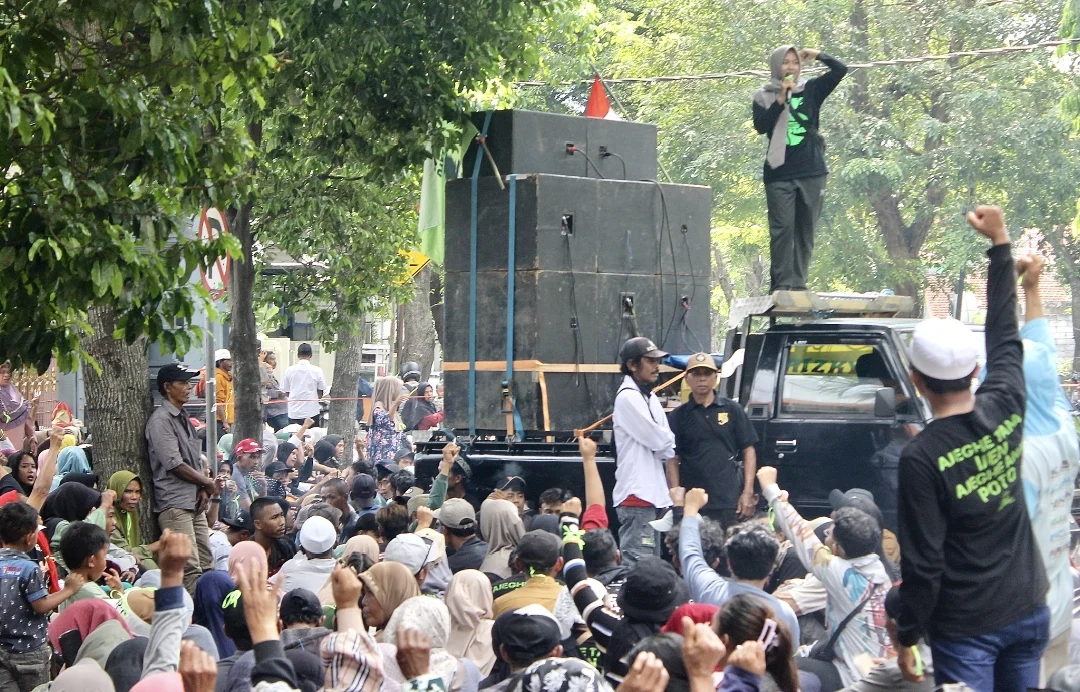
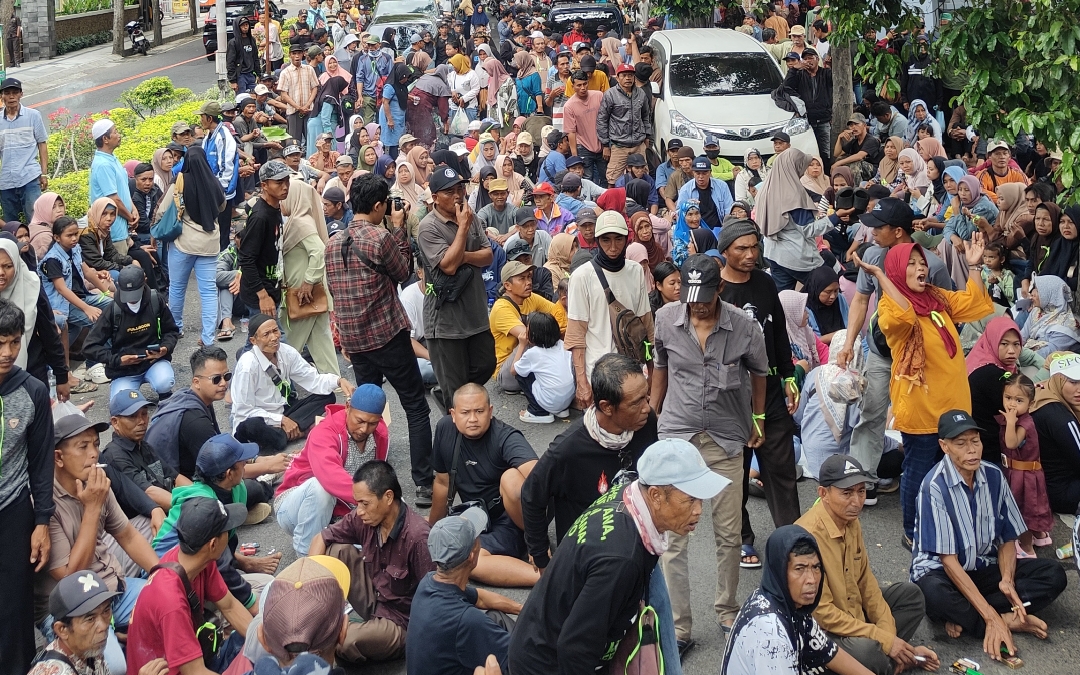
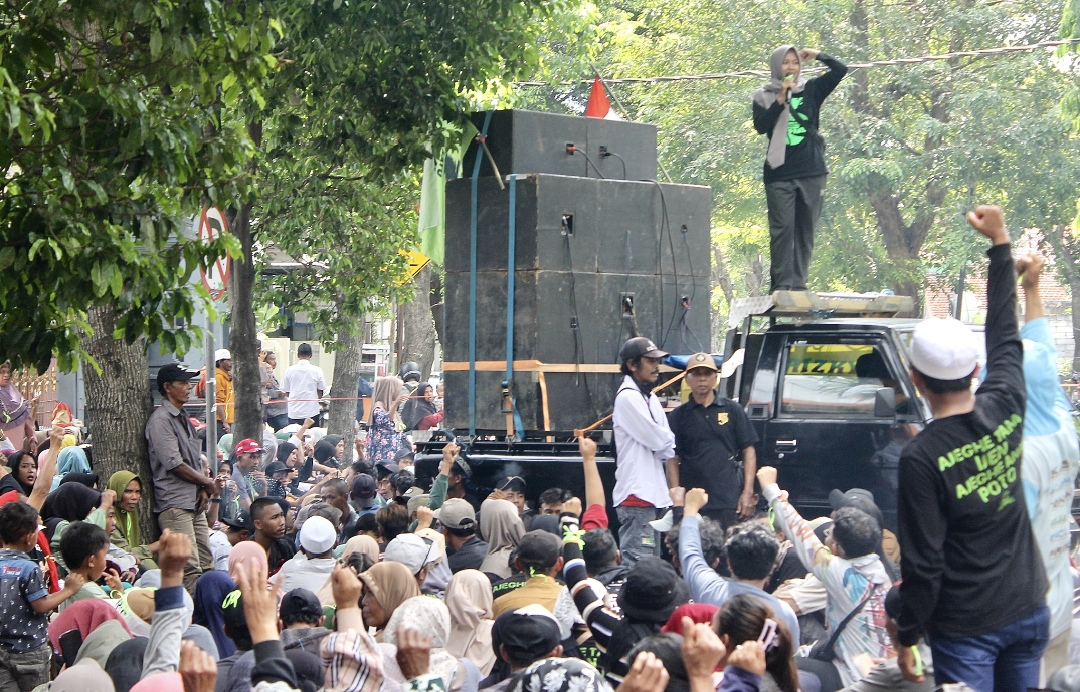
Hundreds of farmers and residents from Pakel Village, Banyuwangi, East Java, gathered at the Banyuwangi District Court on Wednesday, May 6, 2026, to demonstrate solidarity with fellow villagers facing mounting legal pressure from a major plantation company. The mobilization was a direct response to civil lawsuits filed by PT Bumi Sari Maju Sukses (BMS) against two members of the Sumberejo Pakel Farmers Association (Rukun Tani Sumberejo Pakel or RTSP), Suwarno and Sagidin. This latest legal action follows a previous multi-billion rupiah lawsuit against Harun, another prominent Pakel farmer and the chairperson of the RTSP, signaling what advocates describe as a systematic shift in how the corporation handles long-standing land disputes.
Under case number 306/Pdt.G/2025/PN Byw, PT Bumi Sari is demanding that Suwarno pay Rp500 million in damages. Simultaneously, in case number 305/Pdt.G/2025/PN Byw, the company is seeking Rp528 million from Sagidin. Beyond these financial penalties, the plantation firm has requested the court to seize the personal assets and property of both defendants to ensure payment. For the residents of Pakel, these lawsuits are perceived as more than mere legal proceedings; they are viewed as a calculated strategy to instill fear and deplete the community’s resources. During the protest, one farmer emphasized that when subsistence cultivators are threatened with the loss of their homes and hundreds of millions in fines, the matter transcends standard law and enters the realm of psychological and economic warfare.
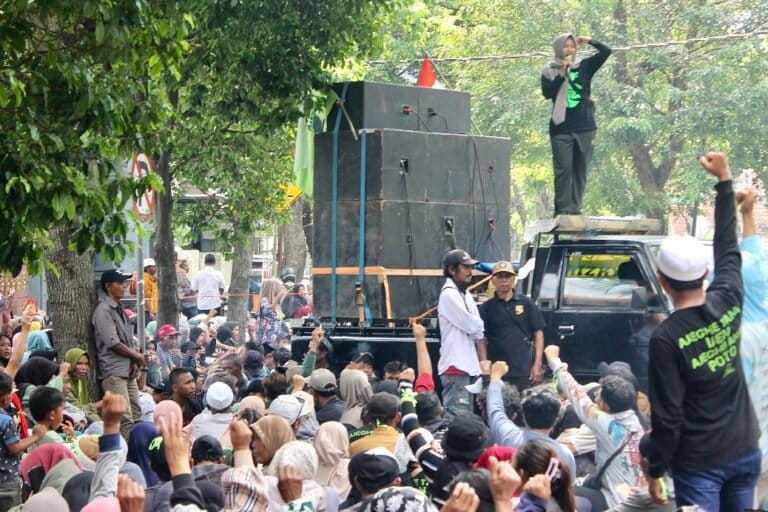
The solidarity movement in Banyuwangi has also drawn support from beyond the village borders. Farmers from Kaligedang, Ijen District, and Bondowoso joined the demonstration, citing shared experiences of agrarian conflict, land inequality, and the persistent threat of criminalization. This collective front highlights a growing regional consciousness regarding land rights and the perceived imbalance of power between rural communities and corporate entities.
The Legal Allegations and Defense Strategies
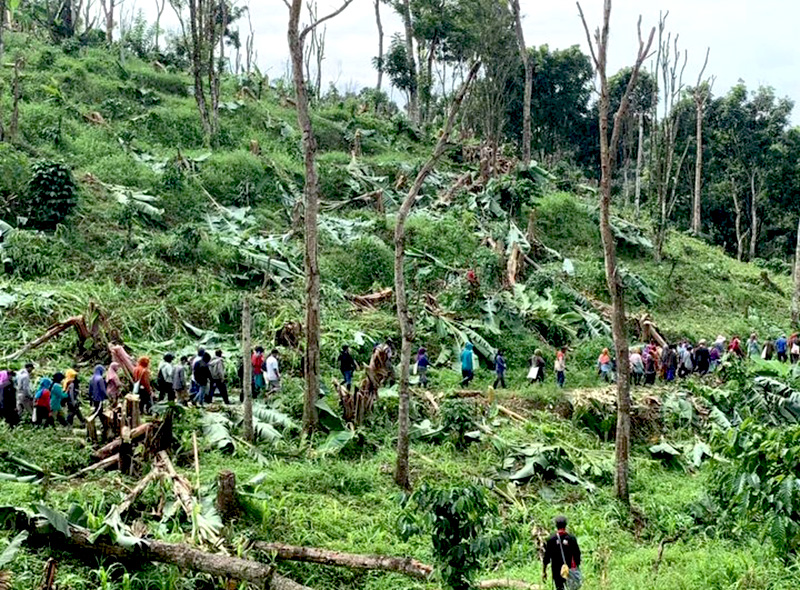
In its filings, PT Bumi Sari Maju Sukses accuses Suwarno and Sagidin of committing "unlawful acts" (perbuatan melawan hukum) by allegedly trespassing into areas claimed under the company’s Right to Cultivate (Hak Guna Usaha or HGU) certificates. The company further alleges that the farmers damaged commercial crops, specifically coffee and clove plants. However, the legal defense team representing the farmers, the Advocacy Team for Agrarian Sovereignty (Tekad Garuda), has vehemently denied these accusations, calling the lawsuits "fragile and problematic" from a foundational legal perspective.
Ahmad Taufiq, a representative of Tekad Garuda, argues that the company lacks strong legal standing. He contends that the residents are not trespassers but are managing land to maintain a "living space" (ruang hidup) that was historically stripped from them. According to Taufiq, the company’s lawsuits conveniently ignore the historical reality of land occupation in Pakel, which predates both the establishment of the Indonesian republic and the presence of the company itself. The defense relies heavily on the "Acta van Verwijzing" of 1929, a colonial-era document that residents claim grants them the right to manage the land.
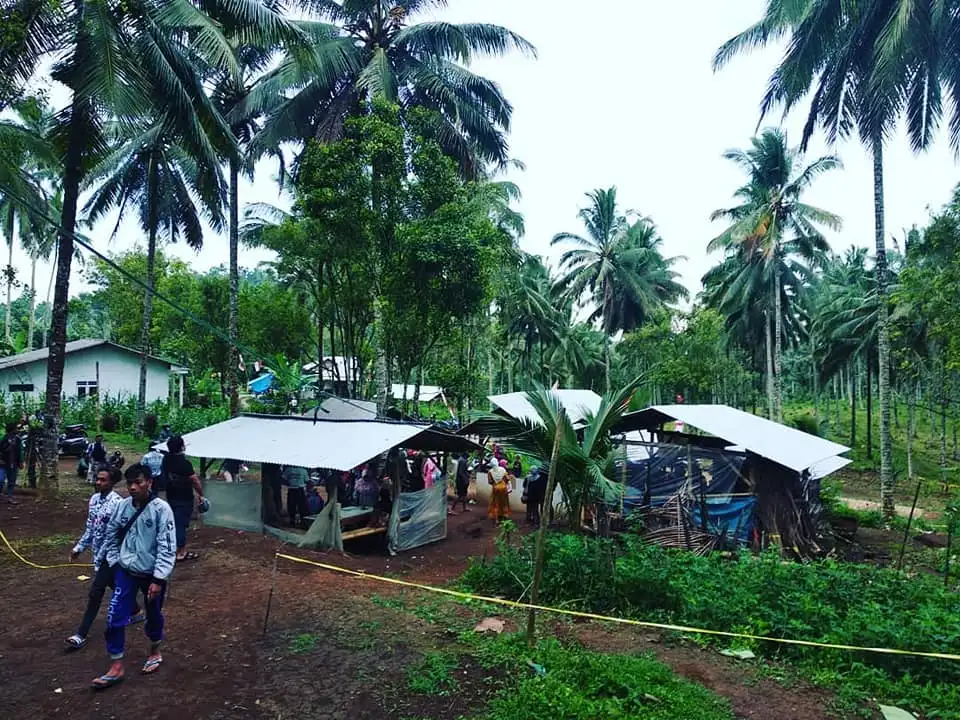
Taufiq further criticized the company’s allegations of crop destruction as simplistic and lacking a clear causal link. He suggested that suing individuals for damages in the midst of a complex, century-old agrarian conflict, without providing concrete evidence, indicates that the litigation is being used as an instrument to displace residents rather than to seek genuine justice. The defense views the demand for massive financial compensation as a form of "systemic impoverishment" intended to uproot farmers from land they have tilled for generations.
From Criminal Charges to Civil Litigation: A Shifting Pattern
The Pakel conflict is one of the longest-running land disputes in East Java, but observers note a recent change in the tactics employed by the plantation company. Fahmi Ardiyanto from the Surabaya Legal Aid Institute (LBH Surabaya) observed that while farmers previously faced criminal charges and police reports, there is now a noticeable shift toward civil litigation. This transition is characterized as a new form of "criminalization" through the civil courts, often referred to globally as Strategic Lawsuits Against Public Participation (SLAPP).
By shifting to civil law, the company can demand astronomical financial damages that are impossible for small-scale farmers to pay. This creates a high-stakes environment where any form of resistance or land reclamation could lead to total financial ruin for the farmers involved. Prior to the suits against Suwarno and Sagidin, Harun, the head of RTSP, was sued for Rp1.4 billion on similar grounds of trespassing and crop damage. Harun has consistently denied these claims, noting a lack of visual evidence or direct witness testimony to support the company’s narrative.
Pradipta Indra, Executive Director of Walhi (The Indonesian Forum for Environment) East Java, stated that the Pakel case demonstrates a recurring pattern of repression that has intensified since 2019. This pattern includes criminal reporting, the naming of suspects, multi-billion rupiah civil suits, and even the restriction of public access to court proceedings. Indra pointed out several irregularities in the company’s lawsuits, including the "vague" status of the defendants—whether they are being sued as individuals or as representatives of the farmers’ association—and the failure to include the Ministry of Agrarian Affairs and Spatial Planning/National Land Agency (ATR/BPN) as a party in the litigation, despite the agency’s role in issuing the contested HGU.
Historical Roots: The 1929 Mandate and Post-1965 Trauma
To understand the intensity of the Pakel conflict, one must look back nearly a century. In 1925, thousands of Pakel residents petitioned the Dutch colonial government to open the Sengkan Kandang and Keseran forests for settlement and agriculture. On January 11, 1929, the colonial authorities granted permission for the opening of approximately 3,000 hectares of land. This document, known locally as "Akta 1929," remains the cornerstone of the villagers’ claim to the land.
The community successfully managed the land through the Japanese occupation and the early years of Indonesian independence. However, the situation changed in the 1980s when PT Bumi Sari began expanding its operations into areas the villagers were already cultivating. Testimony from elderly residents provides a glimpse into this transition. Bagiman, a resident born in 1947, testified that prior to 1982, villagers lived and farmed in the disputed area, maintaining houses and orchards.
The displacement of these farmers in the 1980s was often facilitated by the lingering political trauma of the 1965-1966 period. Residents who resisted the plantation’s expansion were frequently accused of being associated with the banned Indonesian Communist Party (PKI), a charge that carried the threat of disappearance or imprisonment. Bagiman noted that two residents disappeared after such accusations, creating an atmosphere of fear that allowed the company to seize control of the land with little immediate pushback.
Furthermore, legal experts have pointed out a significant gap in the company’s legal claims. Under the Basic Agrarian Law (UUPA) of 1960, all colonial-era erfpacht (leasehold) rights were required to be converted into modern HGU certificates by September 24, 1980. PT Bumi Sari’s HGU certificate was not issued until 1985. Ahmad Taufiq argues that this five-year "legal vacuum" means that under Government Regulation No. 10 of 1961, the land should have reverted to the state rather than being automatically granted to the company.
Government Neutrality and the Path Forward
Despite the escalating tension, the local government of Banyuwangi has maintained a stance of non-interference. Setyo Ardini, representing the Banyuwangi Government Public Relations, stated that the administration is not directly involved in the lawsuits as they are private civil matters between PT Bumi Sari and the farmer groups. Similarly, Agus Mulyono, Head of the National Unity and Politics Agency (Bakesbangpol) of Banyuwangi, expressed that the government is monitoring the situation and encourages both parties to follow the legal process and engage in constructive dialogue.
However, environmental and social activists argue that this "neutrality" is effectively a form of neglect. Lucky Wahyu Wardhana of Walhi Jatim noted that the criminalization of farmers is a widespread phenomenon across East Java, citing similar conflicts in Alasbuluh, Baureno, and Tumpang Pitu. He argued that the state has failed to fulfill the mandate of the UUPA, which emphasizes the social function of land and the need for equitable distribution.
The ongoing trials at the Banyuwangi District Court have also faced criticism for a lack of transparency. In early 2026, the court restricted the number of visitors allowed in the courtroom, citing security concerns. Advocates argue that these restrictions hinder public oversight and undermine the principles of a fair and open trial.
As the legal battle continues, the farmers of Pakel remain steadfast. The presence of hundreds of supporters at the court on May 6 serves as a reminder that the struggle is no longer just about individual defendants, but about the collective right of a community to its ancestral and historical land. For residents like Maryati, the daughter of the sued farmer Suwarno, the fight is about ensuring that the next generation is not deprived of their "ruang hidup" by legal maneuvers and corporate expansion. The court’s eventual decision will likely serve as a landmark for agrarian justice in Indonesia, determining whether colonial-era mandates and historical occupancy can stand against modern corporate land titles.