Nila Kartika Wati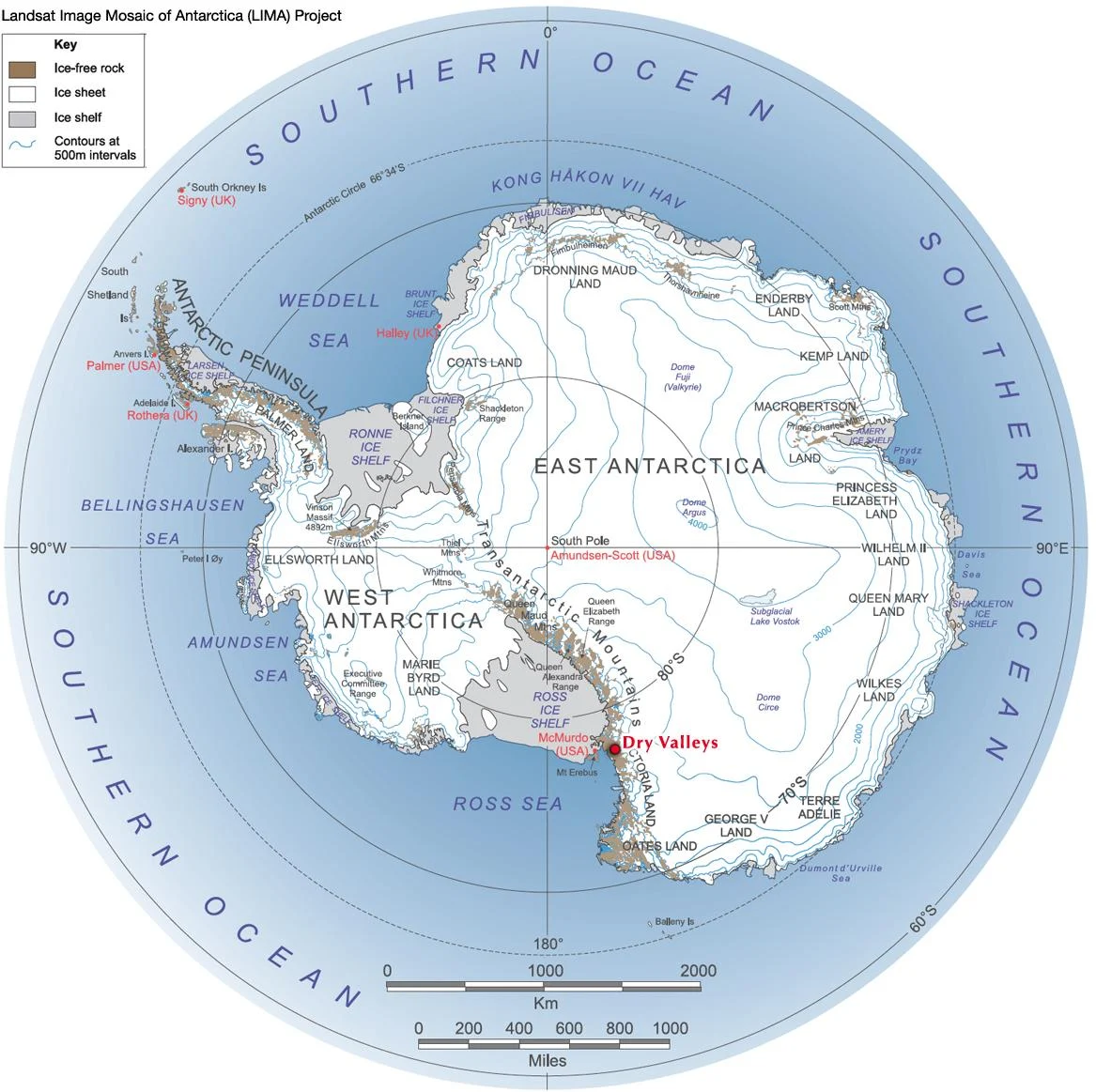
When prompted to identify the driest place on Earth, most observers would instinctively point toward the vast, undulating dunes of the Sahara in North Africa or perhaps the Atacama Desert in South America. The latter, a hyper-arid plateau stretching across the Chilean coast, is frequently cited in popular culture as the "most Mars-like place on Earth." While these answers are grounded in geographic logic, they are scientifically inaccurate. The true record-holder for terrestrial aridity is located far from the blistering heat of the equator. It lies at the southernmost tip of the planet, nestled within a continent synonymous with ice and snow: Antarctica.
Hidden behind the formidable peaks of the Transantarctic Mountains are three distinct valleys—Taylor, Wright, and Victoria—collectively known as the McMurdo Dry Valleys. In these desolate corridors, precipitation has been absent for nearly two million years. To put this timeframe into perspective, while early human ancestors were still migrating across the African savannah, these valleys were already devoid of moisture. Today, they remain an frozen anomaly, a stark landscape of rock and gravel that defies the icy uniformity of the surrounding continent.
An Anomaly in the Heart of the Ice
Antarctica is the world’s fifth-largest continent, covering approximately 14 million square kilometers. Nearly 98 percent of its surface is buried under a massive ice sheet that reaches a staggering thickness of 4,800 meters in certain regions. This ice is not a temporary seasonal layer but a colossal accumulation built over millions of years. Consequently, the general perception of Antarctica is one of a monochromatic, frozen wasteland.
However, the McMurdo Dry Valleys present a radical departure from this image. Spanning roughly 4,500 square kilometers—an area slightly smaller than the Indonesian island of Bali—the valleys constitute the largest ice-free region in Antarctica. Here, there is no crushing weight of glacial ice and no perennial snowpack. Instead, the terrain is defined by exposed granite and gneiss, polished and eroded by relentless winds, and scattered with frozen lakes that harbor hypersaline waters beneath their icy lids.
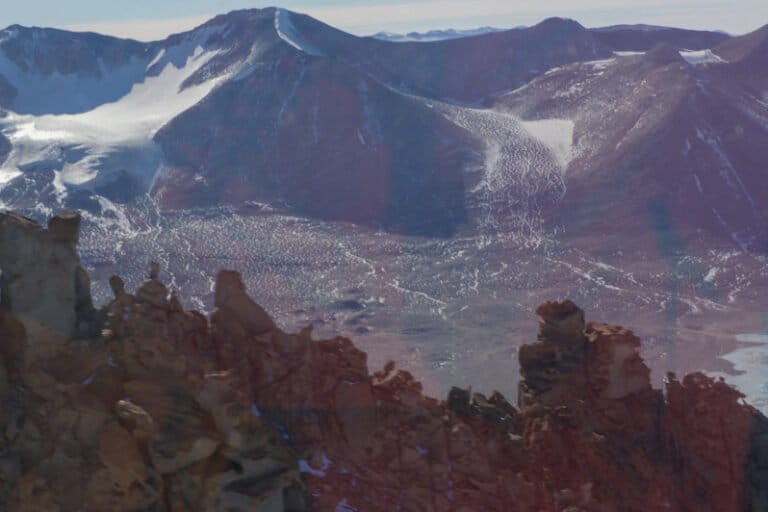
Meteorological data highlights the extremity of this environment. Annual precipitation in the Dry Valleys is estimated to be between 3 and 50 millimeters of water equivalent. In the most arid pockets, this figure drops to zero. For comparison, the Sahara Desert receives an average of 25 millimeters of rainfall per year. Furthermore, research conducted by the University of Auckland in 2005 suggests that the Friis Hills region within the valleys has maintained a stable, hyper-arid climate for 14 to 20 million years, dating back to an era when modern mammalian lineages were just beginning to flourish.
The Dynamics of Extreme Desiccation
The perpetual dryness of the McMurdo Dry Valleys is the result of a unique intersection of geological and atmospheric forces. Two primary mechanisms work in tandem to shield the region from moisture.
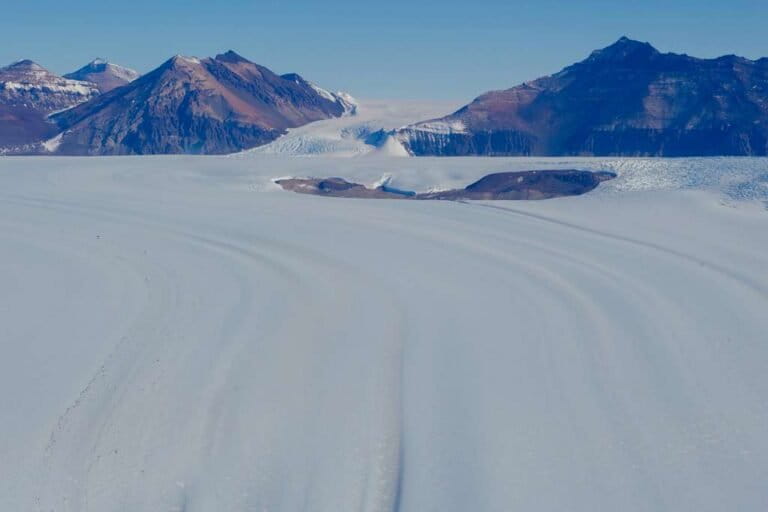
First is the rain shadow effect created by the Transantarctic Mountains. This massive range acts as a physical rampart, obstructing the flow of ice from the East Antarctic Ice Sheet. While the ice sheet pushes against the mountains, the valleys remain protected, preventing glaciers from encroaching into the lowlands. Simultaneously, these peaks block moist maritime air from the Southern Ocean, forcing any potential precipitation to fall on the windward slopes before it can reach the valley floors.
The second, and more dominant, factor is the presence of katabatic winds. These are high-density, gravity-driven winds that form when cold, heavy air over the polar plateau begins to plunge down the steep mountain slopes. As the air descends, it undergoes a process known as adiabatic heating; the increasing atmospheric pressure at lower altitudes compresses the air, causing its temperature to rise. These winds can reach catastrophic speeds of up to 37.8 meters per second (approximately 136 kilometers per hour), equivalent to a Category 1 hurricane.
The heat and velocity of these katabatic winds trigger a process called sublimation. Any snow or ice that managed to enter the valley is instantly converted from a solid state into water vapor, bypassing the liquid phase entirely. This effectively "vacuums" any trace of moisture from the ground, leaving the soil in a state of permanent desiccation.
A Realm of Sub-Zero Extremes
The McMurdo Dry Valleys do not only claim the title of the world’s driest desert; they are also the coldest. While traditional deserts like the Atacama experience high daytime temperatures, the Dry Valleys endure a brutal thermal regime. Average annual temperatures on the valley floors range from -14.8°C to -30°C. During the austral winter, the region is plunged into total darkness for months, with temperatures plummeting as low as -65.7°C, as recorded near Lake Vida. Conversely, during the height of summer, 24-hour sunlight barely brings the temperature above freezing; the record high at Taylor Glacier is a mere 12°C.
Despite these conditions, the valleys host hydrological features that defy conventional expectations. Lake Vanda, located in the Wright Valley, is three times saltier than the ocean. Remarkably, it exhibits a phenomenon known as a thermal inversion: while its surface is capped by 3.5 meters of ice, the water at its deepest point (approximately 60 meters) reaches a temperature of 25°C due to the trapping of solar radiation.
The environment is so hostile that it acts as a natural preservative. Explorers and scientists have discovered mummified remains of crabeater seals and penguins deep within the valleys, kilometers away from the nearest coastline. These animals, having lost their way and wandered into the interior, were preserved by the extreme cold and lack of moisture, preventing the bacterial decay that would normally occur in any other climate.
Life in the "Valley of Death"
When Captain Robert Falcon Scott, the legendary British explorer, first entered the Dry Valleys in 1903, he described the landscape as a "valley of death," believing it to be entirely devoid of life. For nearly a century, this assessment was accepted as fact. However, modern microbiology has revealed that the valleys are far from dead; they are home to "extremophiles"—organisms that have adapted to thrive in conditions that would be lethal to most other life forms.
The most notable inhabitants are cryptoendoliths. These are microbial communities consisting of algae, fungi, and cyanobacteria that live inside the pores of translucent rocks, such as sandstone and granite. By residing a few millimeters beneath the rock surface, they are protected from lethal ultraviolet radiation and the desiccating winds, while still receiving enough sunlight to perform photosynthesis. One specific fungus, Friedmanniomyces endolithicus, has become a primary subject of study due to its ability to survive in these "Mars-like" conditions.

In the thin layers of soil, scientists have also found nematodes (microscopic roundworms), rotifers, and tardigrades. These organisms have developed a survival strategy called cryptobiosis, a state of suspended animation where they lose nearly all their body water and cease metabolic activity until moisture becomes available—a rare event that might occur only once every few decades.
A Terrestrial Laboratory for Astrobiology
The significance of the McMurdo Dry Valleys extends far beyond geographical curiosity. For space agencies like NASA and the European Space Agency (ESA), the region serves as the premier "Mars analog" on Earth. The combination of hyper-aridity, extreme cold, high UV radiation, and low organic content mimics the conditions found on the Martian surface more closely than any other terrestrial location.
For decades, NASA has utilized the Dry Valleys to test the instruments and rovers destined for the Red Planet. The valleys provide a rigorous environment for testing life-detection technologies and biosignature protocols. Scientists argue that if we can understand how life persists in the cracks of Antarctic rocks, we will have a better blueprint for where to look for evidence of past or present life on Mars.
Recent studies have even focused on the "Blood Falls," a plume of iron-rich hypersaline water that seeps from beneath the Taylor Glacier. The discovery of an ancient microbial ecosystem living in total darkness without oxygen in this subglacial brine has fueled speculation that similar life forms could exist in the subsurface oceans of icy moons like Europa or Enceladus.
Conclusion and Global Implications
The McMurdo Dry Valleys stand as a testament to the Earth’s capacity for environmental extremes. As global climate patterns shift, these valleys offer a stable baseline for scientists to monitor the long-term effects of planetary change. Unlike the rest of the Antarctic Peninsula, which is experiencing rapid warming and ice melt, the Dry Valleys have remained largely resilient, preserved by the very winds and mountains that created them.
Through the lens of the Dry Valleys, we see a world that bridges the gap between Earth and the cosmos. It is a place that challenges our definitions of "habitability" and serves as a silent witness to millions of years of geological history. As researchers continue to probe the depths of its frozen lakes and the interiors of its ancient rocks, the McMurdo Dry Valleys will remain a vital frontier in our quest to understand the limits of life on our own planet and beyond.