Nila Kartika Wati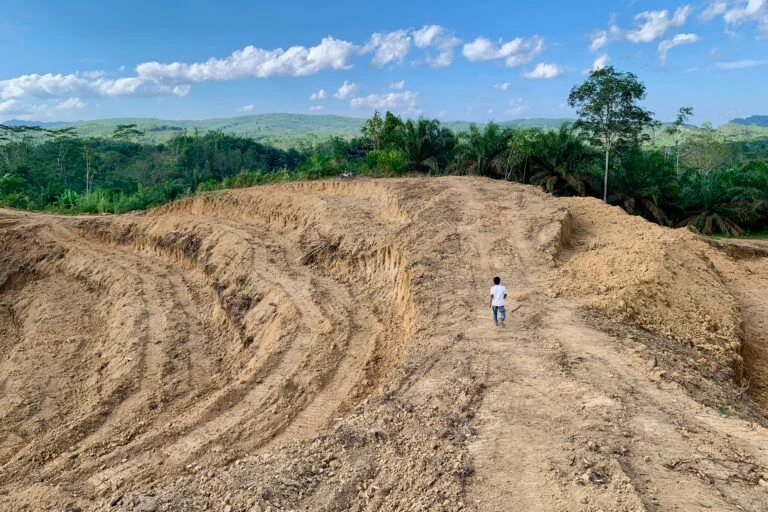
Turani stood at the edge of a deep excavation, her slight frame dwarfed by the massive arm of an excavator. A local street food vendor who makes her living selling fried snacks, she repeatedly attempted to approach the machine to halt its progress, only to be blocked by security personnel. Her protest was born of desperation; her land was being systematically carved away by PT Wirakarya Sakti (WKS), a massive industrial forest plantation (HTI) firm. Despite her cries, the mechanical roar of the machinery continued unabated, a stark symbol of a community’s voice hitting a wall of corporate indifference.
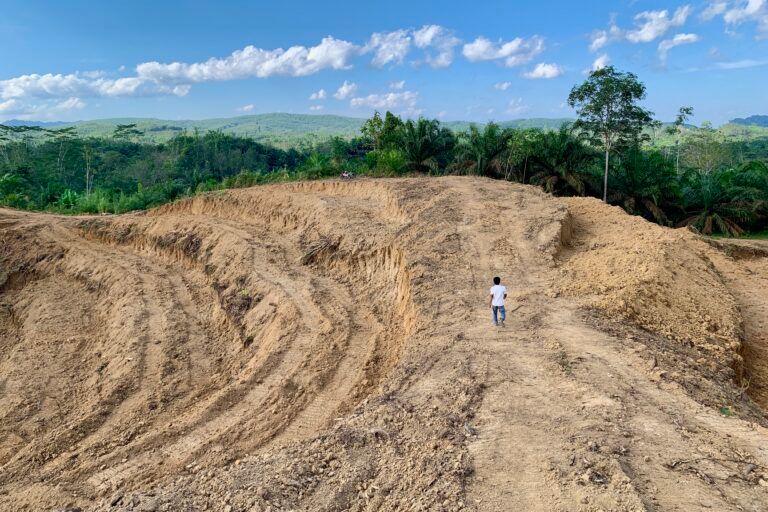
On April 20, 2026, the situation in Bukit Bakar Village, Renah Mendaluh District, Tanjung Jabung Barat, reached a breaking point. PT WKS—a subsidiary of Asia Pulp & Paper (APP) under the Sinarmas Group—deployed heavy machinery to deliberately sever the primary access roads used by the villagers. Over the course of 48 hours, nine strategic points along the road were destroyed, effectively isolating more than 830 residents across two neighborhood units (RT07 and RT09).
The impact was immediate and devastating. Economic activity in the village ground to a halt as farmers found themselves unable to transport harvests to market. Basic necessities became scarce as supply trucks could no longer reach the settlement. Most critically, the blockade severed the education of at least 66 children, who lost their only path to school. What was once a five-kilometer trip to the Simpang Niam–Merlung national road has been transformed into a grueling 25-kilometer detour through treacherous terrain.
The Humanitarian Cost: Echoes of a 2008 Tragedy
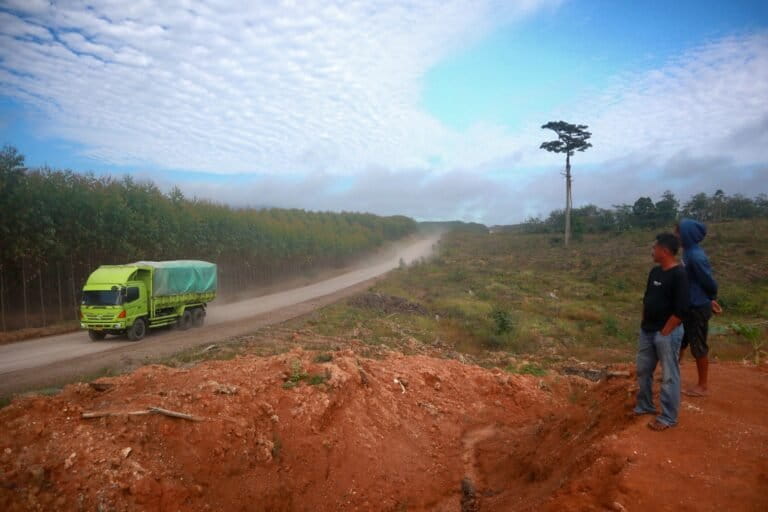
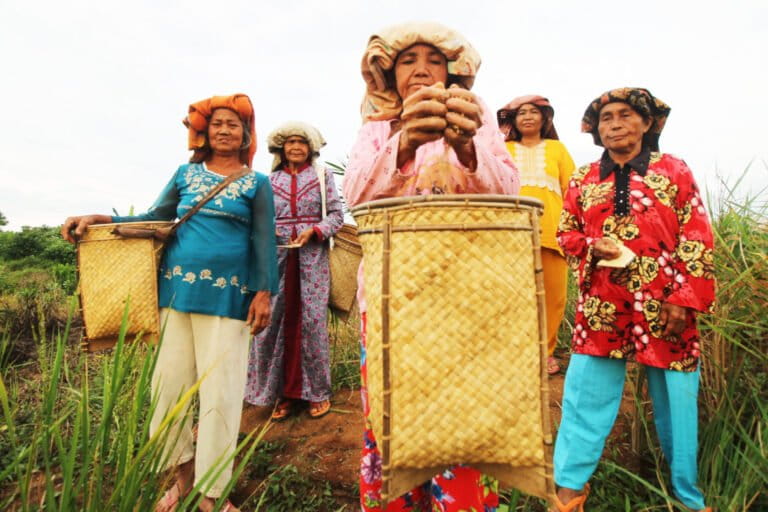
For the residents of Bukit Bakar, the physical blockade is accompanied by a deep-seated psychological dread. Jumirah, a local resident, spoke in hushed tones about the "burden of survival" that now weighs on every household. The detour is not merely an inconvenience of time and fuel; it is a matter of life and death.
"For the middle and high school students, it is the hardest because they have to leave the village," Jumirah explained. "During the rainy season, the detour is impassable. The roads are in terrible condition."
The current isolation has revived the collective trauma of a 2008 tragedy. Jumirah vividly recalls a pregnant woman who went into labor during a period of poor infrastructure. Because no vehicle could reach her, she had to be carried in a traditional sarong sling by villagers, who trekked through kilometers of thick mud toward the nearest health facility. Both the mother and her unborn child died before reaching medical help.
Today, that nightmare haunts the village once more. There are currently seven to eight women in Bukit Bakar in the late stages of pregnancy. With the primary road severed by PT WKS, the community fears that history is destined to repeat itself.
A Timeline of Broken Promises and Failed Dialogue
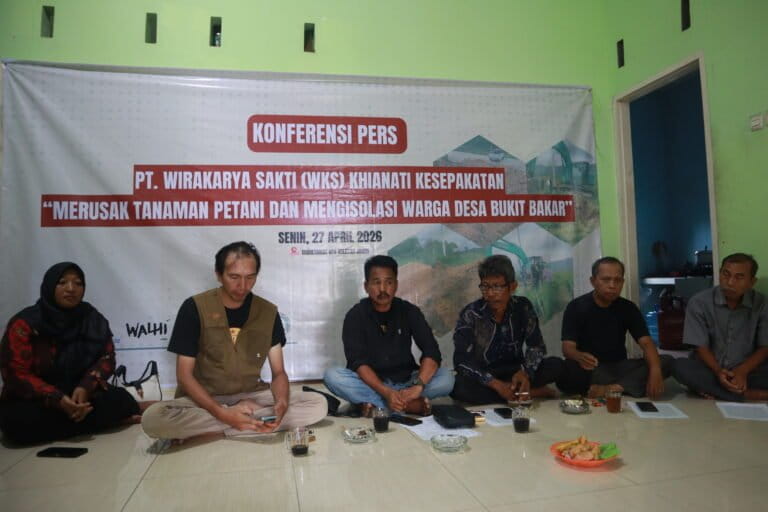
The decision by PT WKS to cut the village roads is particularly galling to residents because it occurred in the midst of what they believed were good-faith negotiations. The following chronology outlines the rapid deterioration of relations in April 2026:
- April 1, 2026: A delegation from Bukit Bakar, including the village head, the village secretary, traditional leaders, and farmer group representatives, traveled to the PT WKS provincial office in Jambi City. Their goal was to seek a permanent resolution to a land conflict that has simmered for two decades.
- April 9, 2026: A follow-up meeting was held at the home of Suwarno, the leader of the Bukit Bakar Jaya Farmer Group. Representing PT WKS were officials identified as Setiadi, Yulianto, and Suroto from District VIII. Two key agreements were reached: both parties would collaborate to create a detailed land parcel map within one week, and both parties agreed to maintain peace and refrain from disturbing each other’s activities during the process.
- April 12, 2026: Suwarno notified PT WKS via WhatsApp that the community had prepared the necessary data for the mapping exercise and requested the company send its survey team.
- April 14, 2026: After receiving no response, Suwarno followed up. He was told by the District VIII mapping team that they could not move without direct orders from superiors.
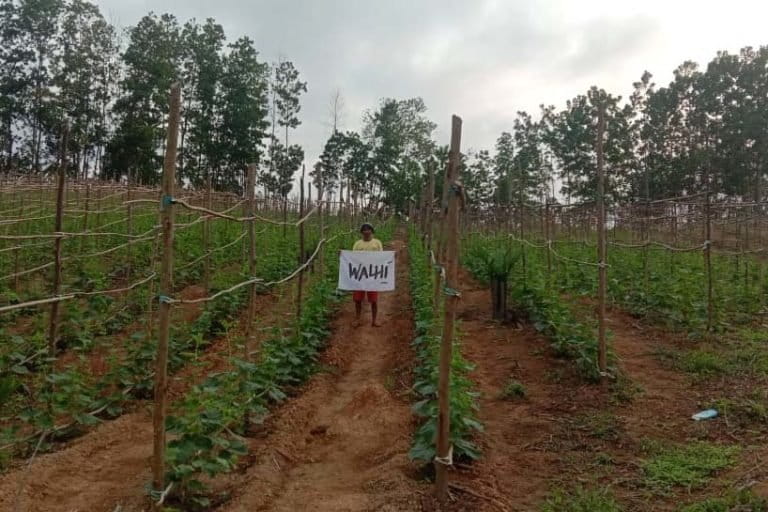
- April 17, 2026: In a sudden shift from mediation to litigation, PT WKS reported Suwarno and Kustoro (the Village Secretary) to the police. The company accused them of masterminding the "illegal occupation" of land after 70 farmers planted bananas on a plot that the community claims is part of the Agrarian Reform Object Land (TORA) proposal.
- April 20, 2026: PT WKS moved in with excavators to begin destroying the village roads.
Sovereignty and Infrastructure: Whose Road is it?
Kustoro, the Village Secretary, argued that the company’s actions were not only a breach of the April 9 agreement but an affront to Indonesian law and village sovereignty. "This road is located within the village administrative area. It does not belong to WKS," Kustoro stated firmly.
The roads in question were developed using a combination of Village Funds (Dana Desa), the Regional Budget (APBD), and voluntary labor and contributions from the residents themselves. By destroying this infrastructure, the company essentially dismantled public assets built with taxpayer money. Kustoro noted that the company provided zero prior coordination or notification to the village government before the excavators arrived.
By April 23, local police and district officials inspected the site, confirming that the number of severed points had increased to ten. Despite the inspection, no concrete action has been taken to restore access. A subsequent meeting on April 24 involving the Regional Representative Council (DPRD) and local government was held at the WKS office, but notably, the people of Bukit Bakar were excluded from the discussion.
Roots of a Two-Decade Struggle
The conflict between the people of Bukit Bakar and PT WKS dates back to the turn of the millennium. Between 1999 and 2003, settlers and locals began cultivating the foothills of Bukit Bakar, planting rice, betel nut, and rubber trees. They built modest huts and formed farmer groups to sustain their livelihoods.
In 2006, PT WKS entered the area. Initially, the company claimed it only needed a 30-meter-wide strip to build a transit road toward Riau. The villagers, believing the road would bring development and better market access, did not object—even when their ripening rice paddies were bulldozed to make way for the path.
However, once the road was completed, the nature of the company’s presence changed. Timber crews arrived to harvest local wood, followed by the large-scale planting of Eucalyptus for pulp and paper production. Since that pivot, the company has systematically expanded its footprint. Since 2006, an estimated 500 hectares of community-managed land have been seized or destroyed. Crops including bananas, ginger, galangal, rubber, and oil palm have been leveled by company machinery.
Corporate Justification: The "Encroachment" Narrative
Setiadi, the Social and Community liaison for PT WKS, defended the company’s actions as a necessary measure for "asset protection." He claimed that the mediation process stalled because the community refused to provide specific "subject and object" data regarding the 500 hectares of disputed land.
"We requested the data of the individual cultivators so we could verify the claims. Because there are hundreds of people involved, verification takes time, and our team is limited," Setiadi said. He alleged that the community instead demanded immediate recognition of the entire 500-hectare block.
Setiadi further justified the road blockade as a preventive measure. He claimed that on April 21, the company found residents from a neighboring settlement, Lubuk Kambing, erecting huts on the concession. "That is why we cut the road—to prevent further encroachment," he stated.
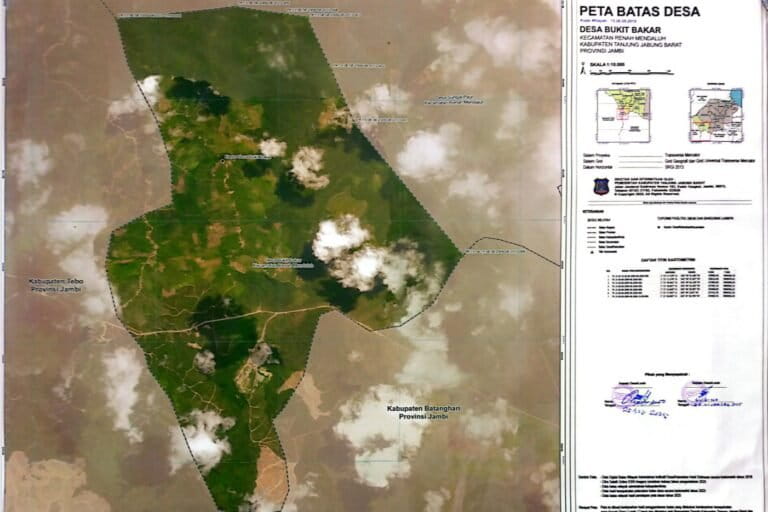
According to company data, nearly the entire 2,300-hectare area of Bukit Bakar Village falls within the WKS concession, with only 117 hectares excluded for residential use under the TORA program. The company offered to reopen the roads only if residents signed a formal pledge never to "encroach" on the disputed lands again—a condition the villagers have flatly rejected.
Broader Implications: A Pattern of Conflict in Jambi
The crisis in Bukit Bakar is not an isolated incident but a microcosm of a systemic issue across Jambi Province. Data compiled by Ekologika, a consultancy for the Forest Stewardship Council (FSC), reveals that approximately 125 villages in Jambi are currently in active conflict with the Sinarmas Group. These disputes span six districts: Tanjung Jabung Barat, Tanjung Jabung Timur, Tebo, Sarolangun, Batanghari, and Muaro Jambi.
Fran Dody, the Jambi Coordinator for the Consortium for Agrarian Reform (KPA), emphasized that the government must evaluate PT WKS’s permits. "This is not a new conflict. It has lasted for years, and the community is always the losing party," Dody said. "If a company’s presence consistently violates the rights of local people and disrupts their survival, the government must have the courage to take firm action, including permit revocation."
Eko Mulia Utomo, Director of the Sejajar Institute, questioned the ethical standing of Sinarmas Group in seeking international sustainability certifications. "Sinarmas is currently attempting to regain FSC certification. But the standards for FSC are very strict regarding human rights and land conflict resolution," Utomo noted. "As of April 2026, PT WKS is still actively committing human rights violations by cutting off village access. They are far from meeting the criteria for a responsible forestry company."
Conclusion: Living in the Shadow of Uncertainty
As the sun sets over Bukit Bakar, the residents remain in a state of high alert. The boundary between company concessions and ancestral village land remains a phantom line, visible only to the company’s legal department but felt by the villagers every time a tractor engine starts in the distance.
"They never want to show us exactly where their concession ends," said Suwarno. "They just keep bulldozing."
For women like Jumirah and Turani, the struggle is no longer just about land; it is about the basic right to move, to learn, and to give birth safely. As the blockade continues, the people of Bukit Bakar are left waiting for a government intervention that has, for twenty years, remained out of reach. Until then, they remain a community under siege, fighting for a future on the very soil they have tilled for generations.