Nila Kartika Wati
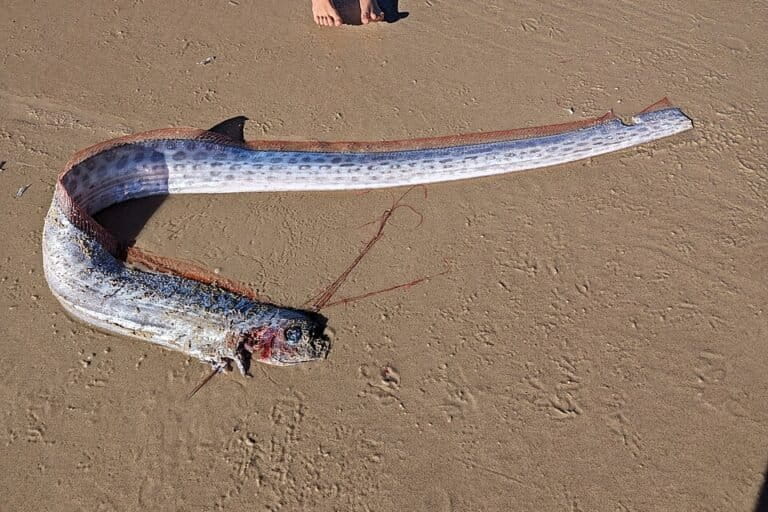
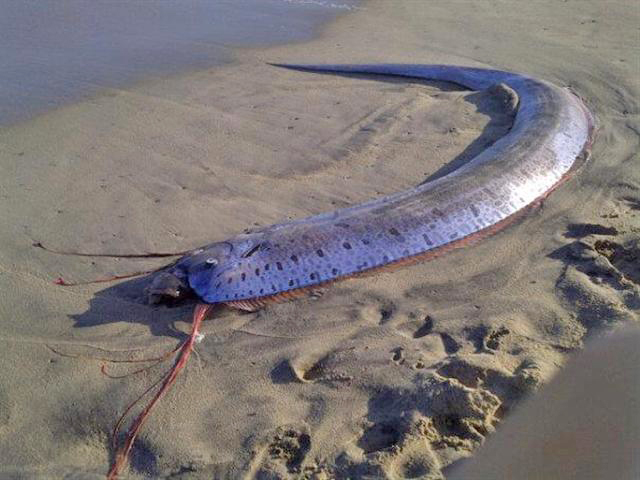
The oceans cover more than 70 percent of the Earth’s surface, yet to this day, less than one-third of the ocean floor has been mapped in significant detail. In these untouched depths, far removed from the reach of sunlight and human interference, creatures that defy the imagination continue their quiet existence. Occasionally, however, the veil between the deep sea and the terrestrial world is lifted when one of these elusive beings washes ashore, sparking global fascination and media frenzies. Among the most striking of these visitors is the oarfish, the world’s longest bony fish. With recorded specimens reaching lengths of over 11 meters, its slender silver body and vibrant, flame-red dorsal fin give it the appearance of a sea dragon plucked directly from the pages of ancient mythology.
Despite its monstrous proportions and intimidating appearance, the biological reality of the oarfish is a study in contradiction. When videos of these 11-meter giants go viral, the public often asks what such a massive predator consumes to maintain its size. Contrary to the terrifying "sea serpent" legends, the oarfish does not hunt large fish, small whales, or even medium-sized predators. Instead, this giant of the abyss survives on a diet of plankton, small crustaceans, and tiny squid—prey often no larger than a human fingernail. This reliance on microscopic nutrients highlights a specialized evolutionary path that favors efficiency and patience over raw predatory power.
A Global Phenomenon: The Unusual Surge of 2025 and 2026
While oarfish sightings were once rare, generational events, the years 2025 and early 2026 have seen an unprecedented cluster of encounters across the globe. This surge has provided scientists with a rare opportunity to study the species, though it has also reignited age-old superstitions. In 2025 alone, at least six significant oarfish encounters were documented, spanning from the Americas to South Asia and Oceania.
The chronology of these sightings began in February 2025, when a headless oarfish washed up on the shores of Baja California Sur, Mexico. The missing head suggested either post-mortem scavenging or a rare predatory encounter in the deep. Months later, the focus shifted to the Indian Ocean. In southern Tamil Nadu, India, local residents and authorities discovered a massive specimen measuring approximately nine meters. The sheer weight and length of the fish required a team of seven people to lift and transport it for examination.

The frequency of sightings accelerated toward the end of the year. Within a single 20-day window, three separate oarfish appeared in the Southwestern Pacific. One was found on the western coast of Tasmania, Australia, while two others were discovered in New Zealand. Notably, both New Zealand specimens were also missing their heads, a recurring detail that has intrigued marine biologists regarding the scavengers that inhabit the transition zones between the deep and the surface.
Scientifically, one of the most significant records of 2025 came from Sri Lanka. Researchers documented the first-ever official sighting of the species Regalecus russellii in the country’s territorial waters. The 2.6-meter specimen, caught off the western coast, provided critical data points for marine biologists mapping the distribution of oarfish in the Indian Ocean, suggesting that their range is far more extensive than previously confirmed. The trend continued into February 2026, when two giant oarfish were spotted swimming in the shallow waters of Cabo San Lucas, Mexico. Although tourists attempted to guide the living fish back to deeper waters, both eventually perished, likely due to the physiological stress of leaving their high-pressure habitat.
The Legend of the Doomsday Fish: Folklore vs. Seismology
In various cultures, the oarfish carries names that reflect its mysterious nature. In Indonesia, it is known as ikan sabuk (belt fish) due to its flat, elongated shape. In many parts of Asia, however, it bears a much more ominous the "Doomsday Fish." This moniker is rooted in the belief that the appearance of an oarfish is a precursor to catastrophic natural disasters, specifically earthquakes and tsunamis.
In Japan, the fish is called ryūgū no tsukai, which translates to "messenger from the palace of the sea god." Traditional folklore suggests that these messengers rise to the surface to warn humans of impending tectonic shifts. This belief gained significant traction following the 2011 Tohoku earthquake and tsunami. In the year leading up to that disaster, which claimed nearly 20,000 lives, several oarfish were reported washing up on Japanese beaches. Because oarfish typically inhabit the mesopelagic zone—depths of 200 to 1,000 meters—their sudden appearance in the shallows feels, to many, like a supernatural event.
However, modern science has sought to decouple myth from reality. A comprehensive study published in the Bulletin of the Seismological Society of America by Yoshiaki Orihara of Tokai University examined this exact correlation. Orihara’s team analyzed 336 deep-sea fish sightings and 221 major earthquakes in Japan over several decades. Their findings were definitive: only one instance showed a potential, yet statistically insignificant, correlation. The researchers concluded that the "Doomsday Fish" legend is a classic example of "illusory correlation," a psychological phenomenon where humans perceive a relationship between two unrelated events because of their unusual or dramatic nature. Scientists maintain that oarfish usually wash ashore only when they are terminally ill, disoriented by changing currents, or dying, rather than as a response to seismic activity.
Breakthroughs in Deep-Sea Research
For centuries, almost everything known about the oarfish was derived from dead specimens. This changed in 2013 when a team led by Dr. Mark Benfield of Louisiana State University published groundbreaking footage in the Journal of Fish Biology. Using Remotely Operated Vehicles (ROVs) in the northern Gulf of Mexico, the team captured the oarfish in its natural habitat for the first time.
The footage revealed a surprising behavioral trait: the oarfish does not swim horizontally like most fish. Instead, it maintains a vertical orientation, with its head pointing toward the surface and its tail hanging straight down. It moves with remarkable agility using its long dorsal fin, which undulates in a rhythmic wave, allowing the fish to move forward, backward, and vertically with minimal effort. This vertical posture is believed to be an adaptation for spotting the silhouettes of tiny prey against the faint light filtering down from above.
More recent scientific efforts have focused on the internal health of these giants. Following the discovery of an oarfish in La Jolla Cove, California, in August 2024, experts from the Scripps Institution of Oceanography at UC San Diego and NOAA Fisheries performed a comprehensive necropsy. This study is of particular importance as it aims to produce the first high-quality chromosome-level genome for the species. Beyond genetics, the necropsy is investigating the presence of modern environmental threats. By analyzing the fish’s organs and tissues, researchers are looking for traces of microplastics and long-lasting pollutants like DDT. As an inhabitant of the deep, the oarfish serves as a biological record of how human-made pollutants are migrating from the surface into the most remote corners of the planet.
Biological Efficiency: How a Giant Survives on Plankton
The oarfish’s ability to reach lengths of 11 meters while consuming only microscopic prey is a marvel of biological efficiency. The key lies in its anatomy, specifically its gill rakers. These are specialized, comb-like structures within the gills that act as a sieve. As the oarfish swims through the water, it filters out krill and plankton, allowing it to feed continuously without the high energy expenditure required for active hunting.
Furthermore, its ribbon-like body is designed for a low-metabolism lifestyle. By moving vertically and relying on its undulating dorsal fin, the oarfish conserves energy in an environment where food can be scarce. It does not possess a swim bladder, the gas-filled organ most fish use for buoyancy; instead, it relies on its fluid-filled tissues and minimal bone density to maintain its position in the water column.
The Broader Impact and Implications
The recent uptick in oarfish strandings has led to broader discussions within the scientific community about the health of our oceans. While the link to earthquakes has been debunked, researchers are investigating whether climate-driven changes in ocean temperatures and currents are pushing deep-sea species out of their natural ranges. El Niño events, for instance, can alter the flow of nutrient-rich cold water, potentially disorienting deep-water inhabitants and leading them into shallower, warmer areas where they cannot survive.
The oarfish remains one of the ocean’s most compelling mysteries. It occupies a unique space where ancient mythology meets modern marine biology. While it may not be a harbinger of doom, its appearance is a reminder of how little we still know about the deep sea. Each specimen found provides a new piece of the puzzle, offering insights into the evolution of bony fish, the health of the mesopelagic zone, and the intricate ways in which life adapts to the most extreme conditions on Earth.
Ultimately, the oarfish is not a dragon or a messenger of catastrophe. It is a testament to the wonders of the natural world—a giant that chooses patience over aggression and a creature that continues to capture the human imagination, proving that the truth of the deep sea is often far more fascinating than the myths we create to explain it. As genomic research and deep-sea exploration technologies continue to advance, the oarfish will likely transition from a "doomsday" omen to a vital indicator of the ecological balance of our global oceans.