Nila Kartika Wati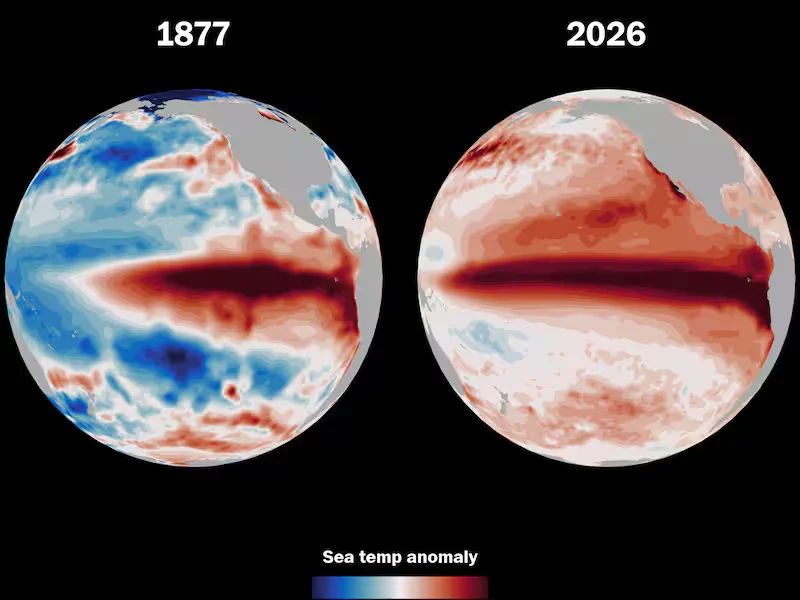
Between the years 1876 and 1879, the planet endured one of the most devastating climatic disasters in modern history, a period marked by a synchronized global drought that triggered a humanitarian catastrophe of unprecedented proportions. Driven by an extraordinarily powerful El Niño event, this period saw the simultaneous failure of seasonal rains across Asia, Africa, South America, and parts of Australia. Unlike localized droughts that allow for regional food transfers, this was a "globalized" crisis where no single region could act as a buffer for another. The result was a staggering loss of life, with modern estimates suggesting that between 30 million and 60 million people perished in less than four years. This death toll exceeds that of many major wars and stands as a testament to the lethal intersection of extreme natural phenomena and inadequate human response.
Scientists today classify the 1877-1878 El Niño as one of the strongest ever recorded, comparable in intensity to the landmark events of 1997/98 and 2015/16. However, the world of the late 19th century lacked the sophisticated infrastructure of the modern era. There were no satellite-based early warning systems, no international humanitarian organizations like the World Food Programme, and no scientific understanding of the El Niño-Southern Oscillation (ENSO) cycle. Governments responded with a mixture of confusion, administrative paralysis, and, in some cases, ideological rigidity that worsened the mortality rates. This era of "Late Victorian Holocausts," as coined by historian Mike Davis, remains a critical case study in how climate volatility can dismantle civilizations when met with systemic political failure.
The Mechanics of a Super El Niño
To understand the scale of the 1876–1879 disaster, one must first look at the mechanics of the El Niño-Southern Oscillation. In a neutral year, trade winds blow from east to west across the Pacific Ocean, pushing warm surface water toward Asia and Australia. This creates a "warm pool" in the western Pacific, which fuels the evaporation necessary for the monsoons in India and the seasonal rains in Southeast Asia. Simultaneously, cold, nutrient-rich water rises to the surface along the coast of South America.
During a "Super El Niño," such as the one that peaked in 1877, these trade winds collapse or even reverse. The massive reservoir of heat stored in the western Pacific surges eastward toward the Americas. This shift fundamentally alters the global atmospheric circulation. The moisture that usually falls over the Indian subcontinent and the Indonesian archipelago is instead dumped into the central and eastern Pacific. This creates a "teleconnection" effect—a chain reaction where an anomaly in the Pacific triggers drought in the Brazilian Sertão, the Ethiopian highlands, the North China Plain, and the Australian outback.
Reconstructions of sea surface temperatures (SST) using coral records and tree rings indicate that the 1877 event was a climatic outlier. The Pacific was not the only ocean involved; researchers believe the Indian Ocean Dipole—a similar temperature see-saw—was also in a "positive" phase, which further suppressed rainfall over India and East Africa. The convergence of these two oceanic anomalies created a "perfect storm" of aridity that lasted for multiple growing seasons.
A Chronology of Global Collapse: 1876–1879
The crisis did not arrive all at once but manifested as a creeping disaster that tightened its grip on the planet over forty-eight months.
1876: The First Signs of Failure
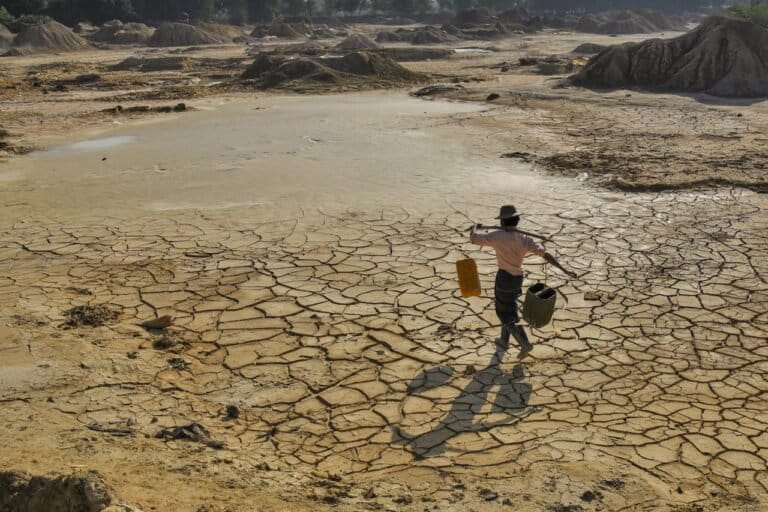
The disaster began in early 1876 when the summer monsoons failed to arrive in southern and western India. By the end of the year, the Madras and Bombay Presidencies were reporting total crop failures. Simultaneously, northern China began experiencing a significant drop in rainfall, marking the start of what would become the "Incredible Famine of the Guangxu Era." In Brazil, the semi-arid northeast (the Sertão) saw its usual seasonal rains vanish, leading to the death of livestock and the drying of essential wells.
1877: The Year of Global Aridity
This was the peak of the El Niño intensity. The Indian monsoon failed for a second consecutive year, an event that historically guarantees mass starvation. In China, the drought expanded to cover five northern provinces, including Shanxi and Henan. The Yellow River, often called "China’s Sorrow," saw its levels drop so low that irrigation became impossible. In Africa, the Nile floods—essential for Egyptian agriculture—were among the lowest ever recorded, and the Ethiopian highlands faced a total failure of the grain harvest. Even in the United States, the West Coast experienced unusual weather patterns, while parts of Australia saw record-breaking heat and drought that decimated sheep populations.
1878: The Secondary Crisis of Disease
While the rains began to return to some regions by late 1878, the humanitarian crisis shifted from starvation to pestilence. Populations weakened by years of malnutrition became easy prey for infectious diseases. In India and China, outbreaks of cholera, smallpox, and malaria tore through refugee camps and decimated villages. In Brazil, the "Grande Seca" (Great Drought) forced hundreds of thousands of "retirantes" (refugees) to flee toward the coast, many dying of thirst and exhaustion along the way.
1879: The Aftermath and Reckoning
By 1879, the El Niño had dissipated, and the rains returned, but the social and demographic fabric of the affected regions was permanently altered. It took decades for population levels in the hardest-hit Chinese provinces to return to pre-1876 levels.
Regional Impacts and the Human Toll
The death toll of the 1876–1879 period was not distributed evenly, and the severity of the famine in each region was dictated as much by political economy as by the weather.
In British-occupied India, the famine claimed between 6 and 11 million lives. The British Raj, led by Viceroy Lord Lytton, adhered strictly to laissez-faire economic principles. Even as millions starved, the colonial administration continued to export record amounts of wheat and rice to Europe. Lytton famously argued that private markets would solve the food shortage and that government intervention would encourage "laziness" among the peasantry. Relief works were established, but they were often located far from the hungriest villages, and the "Temple Wage" (the ration provided to workers) was scientifically determined to be less than the calories provided to inmates at the Buchenwald concentration camp decades later.
In China, the "Northern Chinese Famine" was perhaps the most lethal single event of the period. Estimates suggest that 9.5 to 13 million people died. The Qing Dynasty, already weakened by the Taiping Rebellion and foreign encroachments, found itself unable to transport grain to the landlocked interior. The infrastructure of the Grand Canal had fallen into disrepair, and the lack of railways meant that food aid often rotted or was consumed by the draft animals hauling it before it could reach the starving provinces of Shanxi and Henan. Historical accounts from this period describe a landscape of "silent villages," where the desperate turned to eating bark, "white clay" (kaolin), and eventually, in some recorded instances, human flesh.
In Brazil, the "Grande Seca" resulted in approximately 500,000 deaths. The Northeast of Brazil had always been prone to dry spells, but the 1877–1879 event was so severe that it triggered a mass migration that would define the region’s history. The failure of the Imperial government in Rio de Janeiro to provide adequate aid led to deep-seated resentment in the Northeast, contributing to future social unrest and the eventual rise of millenarian movements.
Scientific Analysis and Modern Implications
The 1876–1879 disaster serves as a stark reminder of the "teleconnections" within the Earth’s climate system. Modern paleoclimatologists, using data from the National Oceanic and Atmospheric Administration (NOAA) and NASA, have used this period to model how extreme ENSO events can override local climate drivers.
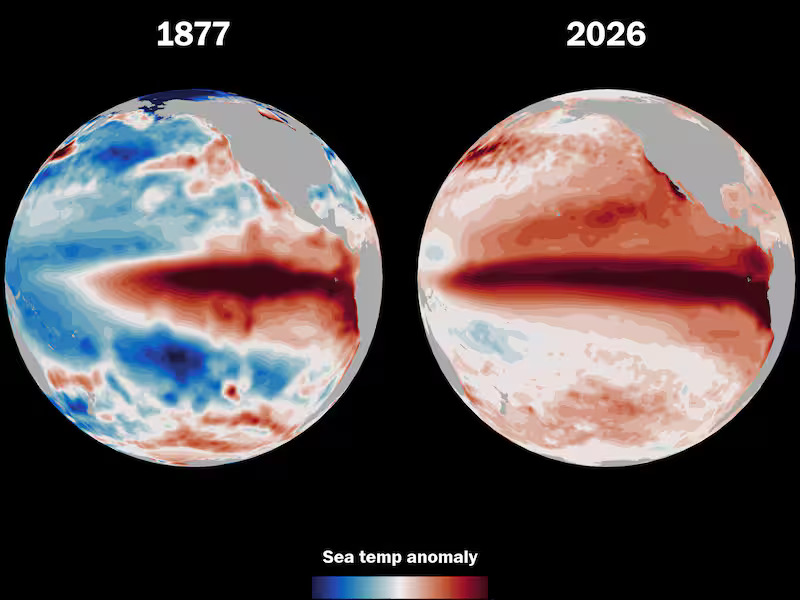
A significant finding in recent years is the role of the Atlantic Ocean during this period. While the Pacific was in a record-breaking El Niño, the Atlantic was experiencing an unusually warm phase. This combination effectively "squeezed" the moisture out of the tropical belt. When we compare the 1877 map of sea surface temperature anomalies with modern data, a chilling pattern emerges: the warming of the oceans due to anthropogenic climate change is beginning to mirror the extreme conditions seen during that 19th-century crisis, but on a more permanent basis.
The primary difference between 1877 and today is our capacity for resilience. In 1877, a farmer in Shanxi or a laborer in Madras had no way of knowing that their plight was shared by someone on the other side of the ocean. Today, the Global Agriculture and Food Security Program (GAFSP) and satellite-based monitoring like the Famine Early Warning Systems Network (FEWS NET) allow for "anticipatory action." However, scientists warn that as the baseline temperature of the planet rises, the "ceiling" for El Niño events also rises. An event with the relative strength of 1877 occurring in the 21st century would test even our modern global supply chains to their breaking point.
Conclusion: The Lessons of a Forgotten Tragedy
The global famine of 1876–1879 was a "natural" disaster only in its inception. Its transition into a global holocaust was a human achievement, facilitated by a lack of international cooperation, the prioritization of profit over lives, and a fundamental misunderstanding of the planet’s interconnectedness.
As we move further into an era of climatic instability, the events of 1876–1879 stand as a warning. They demonstrate that the Earth’s climate is capable of producing "synchronized shocks" that can hit multiple breadbaskets simultaneously. The 30 to 60 million people who lost their lives in the late 19th century were the victims of a world that was becoming globally integrated economically but remained fragmented and indifferent socially. To prevent a recurrence in an era of even greater climate extremes, the lesson is clear: scientific monitoring must be matched by a political willingness to act before the first signs of drought turn into the next global catastrophe.