Nila Kartika Wati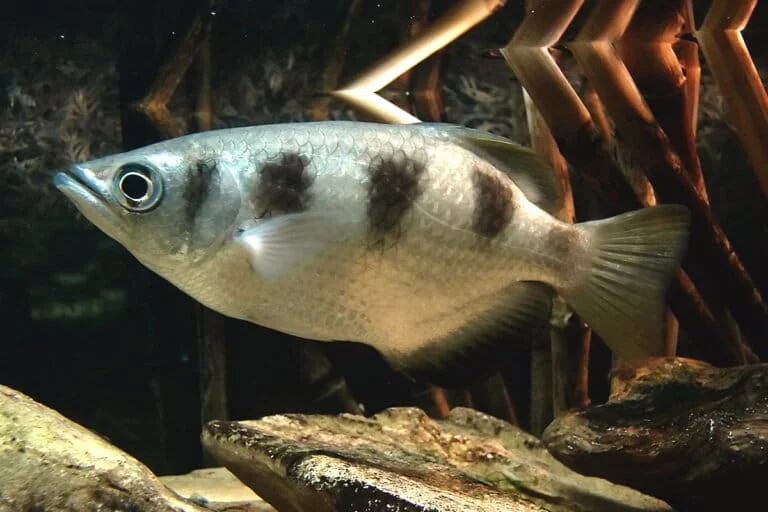
In the shallow, brackish waters of the Indo-Pacific, particularly within the vast mangrove ecosystems of the Indonesian archipelago, lives a small but remarkably sophisticated predator known as the archer fish (Toxotes jaculatrix). Measuring no more than 20 centimeters in length, this unassuming creature possesses a biological weapon that has fascinated naturalists and physicists alike for decades. Unlike most fish that forage beneath the surface or wait for prey to fall into the water, the archer fish has mastered the art of cross-boundary hunting. By utilizing a high-precision stream of water, it can down insects, spiders, and even small lizards perched on overhanging foliage up to two meters above the water’s surface. This ability is not merely a biological curiosity; it represents a complex synthesis of optical physics, advanced hydrodynamics, and cognitive motor adaptation that places the archer fish among the most efficient hunters in the animal kingdom.
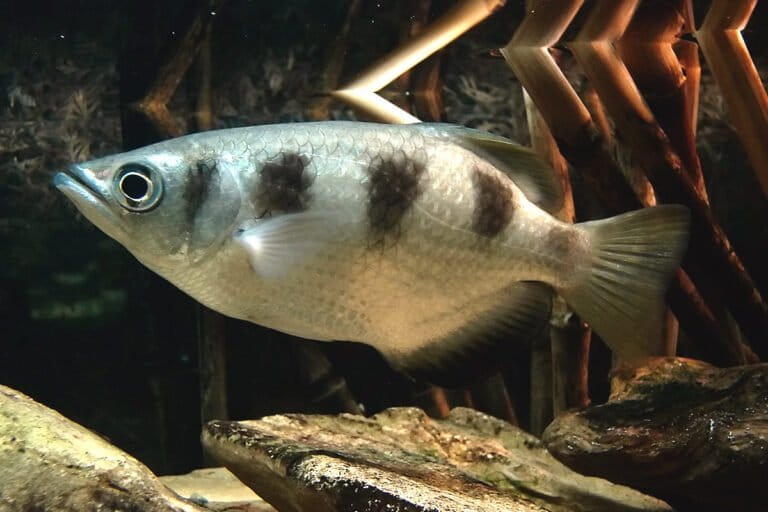
The physical profile of Toxotes jaculatrix is perfectly adapted for its unique lifestyle. Characterized by a silvery, laterally compressed body and a distinctively triangular, pointed snout, the fish is built for upward mobility. Its most striking features are the large, forward-facing eyes that provide binocular vision, essential for depth perception when targeting prey outside its immediate environment. Along its flanks, a series of dark, semi-triangular spots serve as camouflage against the dappled light of the mangrove canopy. However, the true marvel of the archer fish lies within its mouth. A narrow groove runs along the roof of the oral cavity, which, when pressed against by the tongue, forms a barrel similar to that of a blowgun. By rapidly compressing its gill covers, the fish forces a jet of water through this channel, creating a projectile capable of delivering a concentrated kinetic impact.
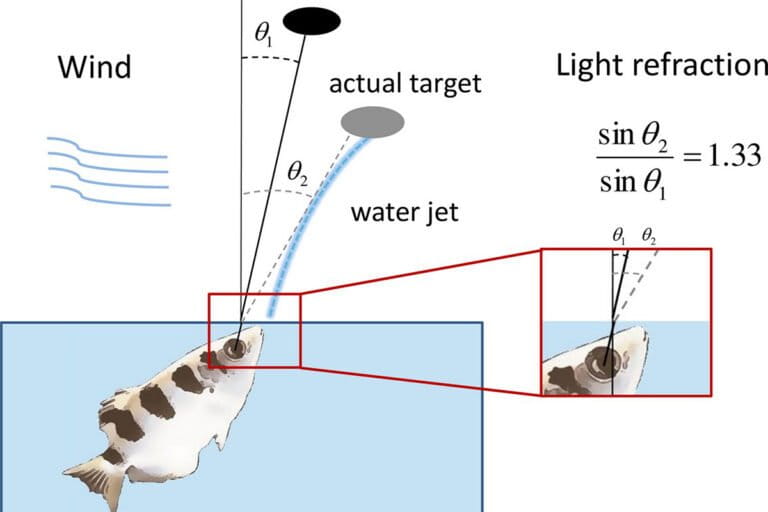
The primary challenge facing an archer fish is not the strength of its jet, but the fundamental laws of physics. When an aquatic predator looks at an object in the air, it encounters the phenomenon of light refraction. According to Snell’s Law, light bends as it passes from a less dense medium (air) to a more dense medium (water). To a fish looking up, an insect sitting on a leaf appears to be in a different position than it actually is—a phenomenon known as "apparent elevation." For a hunter relying on a ballistic projectile, even a slight miscalculation of this angle would result in a missed shot and wasted energy.
Scientific investigation into this optical feat began in earnest with the work of Lawrence M. Dill. In his seminal 1977 study, "Refraction and the spitting behavior of the archerfish (Toxotes chatareus)," published in Behavioral Ecology and Sociobiology, Dill discovered that these fish do not simply fire at the visual target. Instead, they demonstrate an innate or learned ability to correct for refraction with startling accuracy. Dill observed that while the fish is most accurate when positioned directly beneath its prey—where refraction is minimal—it is also capable of adjusting its aim from various oblique angles. This indicates that the archer fish possesses a neural mechanism capable of calculating the true position of its target by accounting for the bending of light at the water-air interface.
Beyond the optical challenges, the archer fish must also master the mechanics of the water jet itself. For a stream of water to knock a tenacious insect off a leaf, it must arrive with sufficient force. If the water were to travel as a simple, thinning stream, the impact would be diffused. However, research conducted by the University of Bayreuth in Germany has revealed that the archer fish actively manages the hydrodynamics of its spit. A 2014 study led by Stefan Schuster and published in Current Biology utilized high-speed cinematography to monitor the propagation of the water jets. The researchers found that the fish does not just "spit"; it modulates the flow of water so that the rear of the jet travels faster than the front.
This "velocity gradient" causes the water to bunch up just before impact, forming a massive, concentrated "slug" of water that delivers maximum kinetic energy to the target. This level of control is achieved by the fish changing the shape of its mouth during the spitting process. For targets at greater distances, the fish opens its mouth more gradually and sustains the duration of the jet, ensuring that the water gathers into a powerful head right at the moment of contact. Schuster’s team noted that this ability to adjust the properties of a projectile after it has left the "launcher" (the mouth) is a level of tool-use sophistication rarely seen outside of primates.
The complexity of the archer fish’s hunting strategy extends into the realm of cognitive science and motor learning. For years, scientists debated whether the ability to shoot was an instinctual reflex or a learned skill. Recent breakthroughs have leaned heavily toward the latter. A 2024 study titled "The archerfish uses motor adaptation in shooting to correct for changing physical conditions," published in eLife, provided groundbreaking evidence of the fish’s cognitive flexibility. A research team led by Svetlana Volotsky at Ben-Gurion University of the Negev demonstrated that archer fish are capable of "motor adaptation"—a process where an organism learns from its mistakes and adjusts its physical movements based on environmental feedback.
In the experiment, researchers introduced a consistent air current (wind) over the tanks of trained archer fish. Initially, the wind caused the water jets to veer off course, leading to missed targets. However, within a few trials, the fish began to compensate for the wind, adjusting their aim and the force of their spit to hit the target despite the atmospheric interference. When the wind was removed, the fish initially "overcorrected" in the opposite direction before quickly recalibrating back to calm conditions. This "after-effect" is a hallmark of motor learning in humans, such as when a person adjusts their gait after walking on a treadmill. It proves that the archer fish is not merely a biological machine executing a fixed program, but an intelligent predator that uses trial and error to refine its craft.
The ecological role of the archer fish in the Indo-Pacific is vital. Found in habitats ranging from freshwater streams to brackish estuaries and coastal mangroves, they serve as a bridge between the aquatic and terrestrial food webs. Their diet is diverse, encompassing bees, dragonflies, spiders, flies, and even small lizards or crabs. By harvesting terrestrial protein and bringing it into the aquatic ecosystem, they contribute to the nutrient cycling of the mangrove forests. In Indonesia, where mangrove biodiversity is among the highest in the world, the archer fish is a keystone species that highlights the intricate connections between land and sea.
The evolutionary history of the Toxotes genus suggests a long-term specialization for this niche. While there are seven recognized species of archer fish, Toxotes jaculatrix is the most widely studied due to its prominent presence in the wild and its adaptability to research environments. The chronology of scientific discovery regarding this fish mirrors the advancement of technology. From Dill’s initial observations in the 1970s using basic film to the 2014 Bayreuth study using ultra-high-speed digital sensors, and finally to the 2024 Ben-Gurion study utilizing complex behavioral modeling, our understanding of the archer fish has deepened alongside our ability to measure the natural world.
The implications of these findings extend far beyond ichthyology. The study of the archer fish’s water jet has significant potential in the field of biomimicry and soft robotics. Engineers are looking at how the fish manages to concentrate liquid into a high-impact projectile without the use of complex mechanical parts. This could lead to more efficient nozzle designs for industrial cutting or new methods for delivering precise amounts of liquid in medical technology. Furthermore, the fish’s ability to process visual information across the water-air barrier provides a biological model for improving underwater surveillance and imaging systems that must account for refraction.
From a conservation perspective, the archer fish serves as an ambassador for the threatened mangrove forests of Southeast Asia. Indonesia has lost a significant portion of its mangrove cover to aquaculture and coastal development over the last half-century. As these habitats disappear, so too does the unique environmental theater where the archer fish performs its daily hunt. The loss of such a specialized predator could have cascading effects on the insect populations and the overall health of the estuarine ecosystem.
In conclusion, the archer fish is far more than a "spitting fish." It is a master of physics and a student of its environment. Through the combination of Dill’s discoveries on refraction, Schuster’s insights into hydrodynamics, and Volotsky’s evidence of motor adaptation, we see a creature that has evolved to solve some of the most difficult challenges in the natural world. Its presence in the waters of Indonesia is a testament to the incredible diversity and ingenuity of life in the Indo-Pacific. As science continues to peel back the layers of the archer fish’s capabilities, it serves as a reminder that even in the smallest corners of nature, one can find the most profound examples of intelligence and adaptation. For the archer fish, the hunt is not just about survival; it is a continuous process of learning, adjusting, and mastering the elements of its dual-world existence.