Nasution Nanang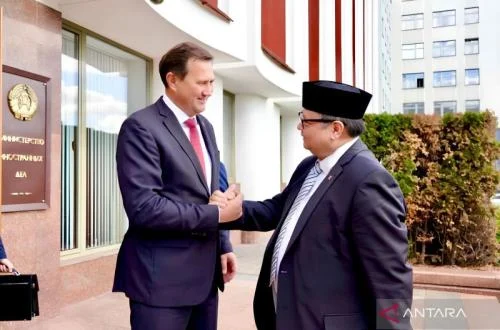
Jakarta, Indonesia – Indonesia and Belarus are actively consolidating a comprehensive roadmap for bilateral cooperation, setting the stage for the highly anticipated state visit of Belarusian President Alexander Lukashenko to Indonesia in July 2026. This pivotal diplomatic and economic engagement was the central focus of a recent bilateral meeting in Jakarta between Indonesian Coordinating Minister for Economic Affairs Airlangga Hartarto and Belarusian Foreign Minister Maxim Ryzhenkov. The discussions underscored a mutual commitment to deepen ties across a spectrum of sectors, emphasizing practical economic agreements designed to yield tangible benefits for both nations.
The roadmap, meticulously crafted during the high-level ministerial consultations, is designed to serve as a strategic blueprint guiding future interactions. It encompasses a broad array of cooperation areas, including trade, investment, humanitarian initiatives, and social-cultural exchanges. This multi-faceted approach reflects a shared vision to foster a more robust and diversified partnership, moving beyond traditional diplomatic courtesies to establish concrete mechanisms for collaboration. Minister Hartarto highlighted the document’s significance, stating that it would form the substantive agenda for President Lukashenko’s upcoming visit, ensuring that discussions are focused on implementable outcomes.
Strengthening Connectivity and Diplomatic Presence
A crucial aspect of enhancing bilateral relations revolves around improving connectivity and diplomatic infrastructure. During the Jakarta meeting, both ministers engaged in detailed discussions concerning the potential establishment of direct flight routes between Indonesia and Belarus. Such a development would significantly reduce travel time and logistical hurdles, thereby facilitating increased flows of tourists, business travelers, and goods. Currently, travel between the two countries often involves multiple layovers, posing a barrier to seamless exchange. The introduction of direct flights is envisioned as a catalyst for boosting tourism, fostering business interactions, and promoting cultural understanding.
Complementing the air connectivity initiative, the officials also explored avenues for enhancing visa cooperation. Streamlining visa processes for citizens of both countries is expected to further incentivize travel and business engagement, making it easier for individuals to explore opportunities in respective markets. This aligns with a broader strategy to create a more accessible environment for bilateral exchanges.
Furthermore, a key diplomatic initiative discussed was the plan to open an Indonesian Embassy in Minsk, the capital of Belarus. This move signifies Indonesia’s serious commitment to solidifying its diplomatic presence in Eastern Europe and deepening its engagement with Belarus. The establishment of a resident embassy would provide a dedicated platform for facilitating political dialogue, economic cooperation, and consular services, ensuring more efficient and direct communication channels between the two governments and their citizens. It would also serve as a vital resource for Indonesian businesses and tourists operating or traveling in Belarus, and vice-versa, bolstering the overall framework of bilateral relations.
Strategic Industrial Cooperation: EVs, Semiconductors, and Potash
A cornerstone of the proposed roadmap is robust cooperation in strategic industrial sectors, identified as critical for the economic resilience and future growth of both Indonesia and Belarus. The discussions highlighted three key areas: electric vehicles (EVs), semiconductors, and potash fertilizers.
Indonesia, with its abundant reserves of nickel – a vital component for EV battery production – is actively pursuing an ambitious strategy to become a global hub for EV manufacturing and battery production. The country aims to leverage its natural resources to attract investment and develop a comprehensive EV ecosystem, from mining and processing to assembly. Cooperation with Belarus in this sector could potentially involve technology transfer, joint ventures in component manufacturing, or even exploring market access for Belarusian industrial expertise relevant to heavy machinery or specialized vehicle production, adapting it for the EV context. This aligns with Indonesia’s broader industrial downstreaming policy, which seeks to add value to raw materials domestically rather than exporting them unprocessed.
The global semiconductor industry has faced unprecedented challenges in recent years, including supply chain disruptions and geopolitical tensions, underscoring the strategic importance of this sector. Indonesia recognizes the critical need to strengthen its position in the semiconductor value chain, not just as a consumer but also as a producer. Discussions with Belarus could explore potential collaborations in research and development, talent training, or even niche manufacturing segments, leveraging any existing Belarusian expertise in microelectronics or precision engineering. While Belarus might not be a global semiconductor giant, any collaboration could contribute to Indonesia’s long-term goal of diversifying its technological capabilities and reducing reliance on external sources for critical components.
Perhaps one of the most significant and immediate areas of cooperation is in the supply of potash fertilizers. Belarus is one of the world’s largest producers and exporters of potash, a vital nutrient for agricultural productivity. For Indonesia, a vast archipelago with a significant agricultural sector and a growing population, ensuring food security is a paramount national priority. Reliable and affordable access to potash is essential for maximizing crop yields and maintaining agricultural sustainability. By establishing a direct and stable supply channel for potash from Belarus, Indonesia aims to diversify its fertilizer sources, reduce dependency on a limited number of suppliers, and mitigate risks associated with global commodity price volatility and supply chain disruptions. This collaboration is expected to directly support Indonesia’s food security agenda and enhance the resilience of its agricultural sector.
Trade Liberalization through the Indonesia-Eurasian Economic Union FTA
A pivotal agenda item during the bilateral meeting was the progress of the ratification of the Indonesia-Eurasian Economic Union Free Trade Agreement (I-EAEU FTA). This agreement is poised to significantly enhance trade relations between Indonesia and the EAEU member states, which include Russia, Kazakhstan, Belarus, Armenia, and Kyrgyzstan.
Foreign Minister Ryzhenkov confirmed that the Belarusian parliament has already ratified the I-EAEU FTA, and the agreement is currently awaiting the signature of the President of Belarus to complete the domestic ratification process. This demonstrates Belarus’s strong commitment to the trade pact. On the Indonesian side, Minister Hartarto indicated that Indonesia is targeting the ratification of the I-EAEU FTA in the second half of 2026. The synchronization of these ratification timelines is crucial for the timely entry into force of the agreement.
The I-EAEU FTA is expected to unlock substantial trade potential by reducing tariffs and non-tariff barriers, streamlining customs procedures, and creating a more predictable trade environment. For Indonesia, this agreement offers enhanced access to a market of over 180 million consumers within the EAEU, presenting new opportunities for its diverse range of products, from agricultural commodities and processed foods to manufactured goods and services. Conversely, EAEU members, including Belarus, will gain preferential access to Indonesia’s large and rapidly growing market of over 270 million people. This agreement represents a strategic move for Indonesia to diversify its export markets and reduce its reliance on traditional partners, while for Belarus and the EAEU, it signifies strengthened economic ties with a key Southeast Asian economy. The EAEU, established in 2015, aims to facilitate the free movement of goods, services, capital, and labor among its member states, and FTAs with external partners like Indonesia are central to its broader economic integration strategy.
Human Capital Development and Cultural Exchange
Beyond economic and trade considerations, the discussions also extended to vital areas of human capital development and cultural exchange. A notable proposal from Belarus involved programs for sending Indonesian students and professionals to Belarus, particularly in the health sector. Belarus is recognized for its well-regarded medical education and healthcare standards, making it an attractive destination for specialized training. Minister Hartarto expressed strong support for this initiative, acknowledging the importance of enhancing Indonesia’s human resources capabilities.
Furthermore, Minister Hartarto articulated Indonesia’s desire to expand such exchange programs to include Science, Technology, Engineering, and Mathematics (STEM) fields. This aligns perfectly with President Joko Widodo’s national agenda to foster a digitally literate and technologically advanced workforce capable of driving innovation and economic transformation. By providing opportunities for Indonesian talent to gain international exposure and specialized knowledge in STEM, the program would contribute directly to Indonesia’s long-term development goals. These educational and professional exchanges are not only about knowledge transfer but also about building enduring people-to-people connections, fostering mutual understanding, and creating a network of future leaders and innovators who can further cement bilateral ties.
Historical Context and Geopolitical Significance
Indonesia and Belarus have maintained diplomatic relations since 1993, but engagement has historically been modest compared to Indonesia’s ties with other major global powers. Past high-level interactions have laid a foundational groundwork, with sporadic ministerial visits and bilateral consultations. However, the upcoming visit of President Lukashenko, preceded by intensive preparatory meetings, signals a deliberate and concerted effort to elevate the relationship to a more strategic level.
For Belarus, strengthening ties with Indonesia and other Asian nations is part of a broader "pivot to the East" strategy, driven partly by geopolitical shifts and the desire to diversify economic and political partnerships beyond its traditional European sphere. Indonesia, as the largest economy in Southeast Asia and a prominent member of ASEAN, offers a significant market and a strategic partner in a dynamic region. For Indonesia, deepening relations with Belarus aligns with its long-standing non-aligned foreign policy and its commitment to fostering diversified international partnerships. It allows Indonesia to explore new markets, secure critical resources, and gain access to specialized technologies from a broader range of countries, enhancing its strategic autonomy and resilience in an increasingly complex global landscape. This partnership reflects Indonesia’s pragmatic approach to foreign policy, seeking mutually beneficial collaborations regardless of geographical distance or differing political systems.
Economic Data and Bilateral Relations Analysis
While specific granular trade and investment figures between Indonesia and Belarus are not always widely publicized, available data indicates that bilateral trade volumes have historically been relatively modest but possess significant growth potential. In recent years, total trade has fluctuated, with Indonesia primarily importing fertilizers, machinery, and some industrial goods from Belarus, and exporting agricultural products, palm oil derivatives, and some manufactured goods. The current trade figures do not fully reflect the potential for cooperation, especially given Belarus’s strengths in industrial machinery, agricultural technology, and potash, and Indonesia’s vast consumer market and growing industrial base.
The I-EAEU FTA is expected to be a game-changer, providing the necessary institutional framework to substantially boost trade and investment flows. An analysis of the implications suggests that with reduced tariffs and enhanced market access, trade volumes between Indonesia and the EAEU, including Belarus, could see a significant uptick, potentially reaching several billion dollars annually within a few years of the FTA’s implementation. Investment, particularly in strategic sectors like manufacturing, infrastructure, and mining, is also anticipated to grow as regulatory barriers are lowered and business environments become more predictable.
Challenges and Opportunities
Despite the strong momentum, several challenges need to be addressed to ensure the long-term success of this enhanced partnership. Geographical distance and logistical costs remain inherent hurdles that direct flight routes and efficient shipping channels aim to mitigate. Differences in business cultures and regulatory frameworks also necessitate ongoing dialogue and mutual understanding. Furthermore, geopolitical developments and global economic fluctuations can always impact bilateral relations, requiring adaptive strategies from both sides.
However, the opportunities far outweigh these challenges. For Indonesia, the partnership offers diversified sources for critical agricultural inputs like potash, access to specialized industrial technologies, and new export markets in Eastern Europe and Central Asia through the EAEU. For Belarus, it provides access to the rapidly expanding Indonesian market, a gateway to the broader ASEAN region, and opportunities for collaboration in areas like EV development and human capital exchange. This strategic partnership represents a forward-looking approach for both nations to navigate a changing global order, seeking mutual prosperity through diversified and strengthened international cooperation.
The extensive preparations and the upcoming visit of President Lukashenko underscore a shared commitment to building a resilient, multifaceted partnership between Indonesia and Belarus. The roadmap, encompassing economic, diplomatic, and human development dimensions, is set to solidify a new chapter in their bilateral relations, promising substantial benefits for both countries in the years to come.